A group of us went back to Sliding Rocks today to go explore further up the river. The four guys on the group went, as did two Samoans and two Fijians. Last time most of us had been a little hesitant to slide down the nearly vertical ten foot drop of the highest rock, but today it was viewed as just a means to cool off after the hike up the mountain and before heading up stream. Most tourists and visitors come for the sliding rocks- several deep pools of water fed by small water falls. You sit at the top and *whoosh* the water takes you down into the water below. It’s lots of fun, but we wanted to go up further to another waterfall the Fijians had told us about. We hiked for about 45 minutes, following the river bed and climbing over stones and fallen trees. It was so unlike most hiking where you follow a trail. Here the river was quite literally the trail. At one point we came to a place where the river flowed between two thirty foot cliffs. It looked like a fun place to go bouldering. We reached the next waterfall, not nearly as dramatic, but covering a small cave. We didn’t slide or jump from this waterfall though because there was a rock in the middle of the pool. That’s why you go with people who know the area! There are no warning signs. From this waterfall the path got a little more tricky. The goal was to go as far as possible before it got to the point where it was just not safe to keep going. Mala, one of the Fijians, went to the river’s source last year. He said it was just a trickle, and we got pretty close. We turned back however because it would have required some pretty dangerous moves. The furthest most of us got was ten minutes past the waterfall cave. We pulled a superman climb to get to another big pool and then decided that we didn’t really want to do a climb that required standing on Mala’s back to reach the next foot hold. That’s when we turned around and came back. It was a lot of fun though. Days like this are among my favorite here in Samoa. They are so relaxing!
Ok so now I have to tell a funny story that just happened about two minutes ago. You might not find it as funny as I do, but it had me laughing out loud in the computer lab. I was copying some pictures from Sliding Rock off of Jared’s CD and onto my memory stick. I finished opened the CD drive and turned to put my memory card into my backpack. I looked up a minute later and the drive was empty. I was so confused. I looked at it for a second, looked around me at the desk, opened the CD case. That’s when I hear Dan cracking up next to me. He’d gotten me good. I really had no idea what in the world had happened to that CD!!! Anyways, enough of that.
I’m really excited because the trip to Apolima just might work out. If it does it would be awesome beyond description.
And now I just have to make one little disclaimer. I know I refer to a lot of my friends here by their nationality- Tongan, Fijian, Samoan are the three big ones. This was something we’d actually talked about in class a few weeks ago. Back in the States people are only given the chance to identify themselves as Pacific Islanders, but that really isn’t an accurate description. While its true that there are some similarities between the cultures and uniting gives them more of a voice in international discussions they do not necessarily view themselves as the same. Their islands might not be large by world standards but they have extreme pride in their national identity. And again, even though to an outsider all Pacific Islanders might look similar and indeed it is hard to tell some of them apart due to inter-marriage etc, you don’t really ask someone what country they come from. I can’t tell you how many times I’ve been asked “Cant you tell?” They can see the physical characteristics that set them apart very well. That and I guess there is a difference in language and diction but ya know…
Note: in the time its taken me to finish typing up this entry I just got an email from one of the guys at EPC and it looks like Apolima might be a go!!!! AGHHHHHHH YES YES YES!!!!!! You’re probably wondering what in the world I’m so excited over. Apolima is a really small island between Upolu and Savaii. Only nine families live on the island and its really hard to get to and you have to have special contacts and it costs quite a bit of money to go out there and I’m getting to go with EPC and maybe help them with a project and this is like way super cool.
Saturday, November 11, 2006
Friday, November 10, 2006
Short and sweet
Today was a long day. I spent two hours this morning waiting for the computer lab to open so that I could check my email because I’m trying to set up interviews for my research project. The internet on campus normally only works from 8-10am and from 4-10pm, so not being open for two hours would normally mean that I would have to wait until 4pm to check my email. Fortunately, for some odd reason, the internet was on all day today. Maybe it has something to do with being routed through Fiji where it is now Saturday? I don’t know. I haven’t figured it out.
The only good thing about waiting was that I finished reading The Little Prince. Several of my friends really like it so when I saw it in the SIT office I picked it up to read. I’d skimmed parts of it before but reading the whole thing…there are just so many things that ring true. One of my favorite quotes of all times is from that book: “What is important is invisible to the eye. It is only with the heart that one can see clearly.” Cela, if you’re reading this you should read it and then let me know what you think.
This afternoon I made some more phone calls to try to set up interviews and then went to UNDP to meet with one of the consultants there. I think I’ve said this before but people here are so friendly and eager to help. It’s such a small place that there are very few people who are not accessible.
Afterwards I came back and played tennis with the Tongan guys. I’m not that great but then again neither are most of them and they think its hilarious that a palagi girl is playing with them. Every time I walk by when they’re playing I get an invitation to play with them. It’s good fun.
Buying groceries
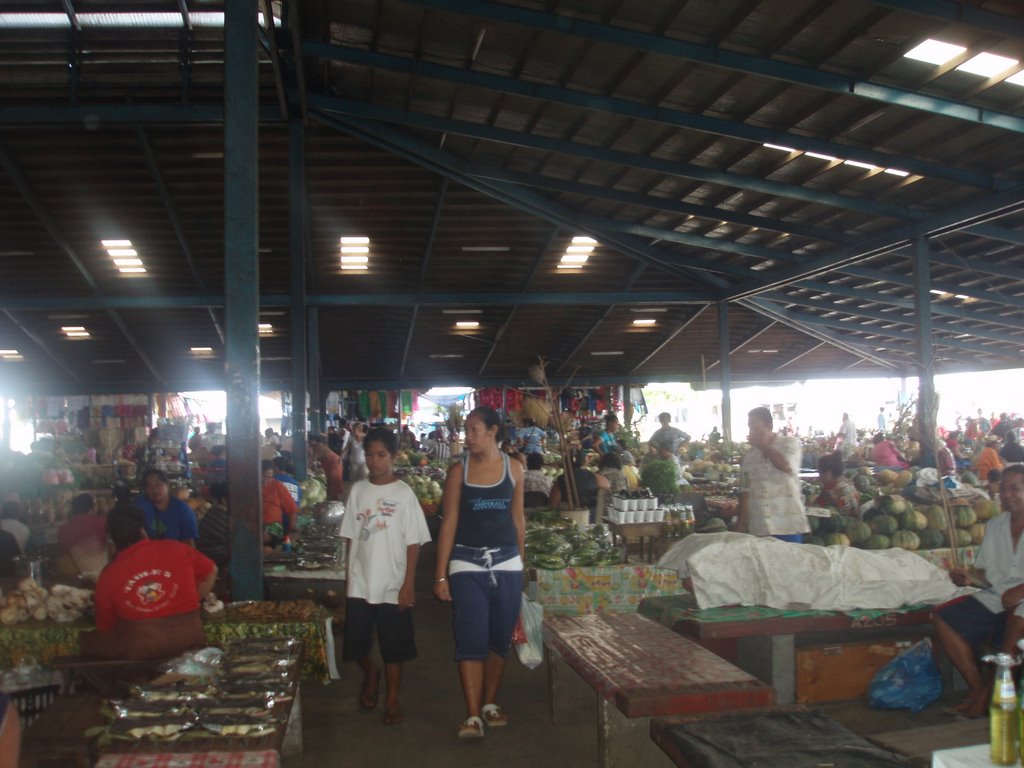
Today most of us went in to Apia to do some grocery shopping so that we didn’t have to live on biscuits and corned beef all weekend. I have a hard time in general grocery shopping for one person, but grocery shopping for one person for one month is going to be quite a challenge for me. As a group I’m sure we’ll end up sharing some things and cooking some meals together, but since we’ll be here and there it was much easier to just be responsible for our own individual selves.
I have to admit that I have not done much food shopping since I’ve been here. There hasn’t really been a need to. There are several places you can go to buy food in Samoa. The first is the small faleoloa. These are everywhere in Samoa. In fact, one of the boys is doing his research on the economics of them. There are at least four of which I am aware in about a five minute walk from the front gate of the USP campus. The same holds true in the villages. They can be right across the street from each other. I don’t understand how they manage to stay in business. The point however is that these faleoloas hold very basic necessities: a few canned goods, biscuits, cold drinks and Vailima, candy, and cigarettes. I think some of the ones in villages further from Apia might also sell frozen chicken and bread. I really haven’t figured out how they decide what to sell in them, but most of us frequent them to buy their biscuits or “pane keke.” They make good snacks. Most of these stores are either part of a house or just a small building and there is no need to enter them at all. You walk up to the counter and pretty much point to the items that you want because they are all arranged along the wall. Basically, they are pretty small.
The next place to buy food is the supermarket. There are a few bigger ones in Apia, and by bigger I mean they are somewhat like the Samoan equivalent of a super Walmart or Target. You can buy food and clothes and some kinds of other supplies in them. The two that I’ve been in are about the size of a big drug store. There are also some smaller supermarkets that just have food and they are more the size of a smaller drug store. I went to one of those today with Mirna and Michaela. We walked through the isles and it was somewhat of a challenge to decide what to buy. They don’t have a lot of things that we take for granted back home and many of the “Western” things they do have are extremely expensive. We decided that we are going to be making lots of stir frys so we bought marinades and spices and rice. We also bought the locally popular cereal- Wheat Bix, which is also the only cereal that costs less than WS$20. Unfortunately they don’t have milk in Samoa so our options are powdered milk in a bag and milk cream that only needs to be refrigerated after it has been opened and has a shelf life of six months.
The third place to buy food is the market. It’s where you can buy all your fresh fruits and vegetables. They really don’t have many in supermarkets except for imported fruits like apples and pears, which are not sold in the market. I enjoy going to the market. It’s fun to walk through and just see table after table lined with tomatoes and papayas and squash/pumpkins and bananas and cabbage and cocoa and green beans and cooked taro with palusami. The fruit/vegetable market is always open and people even sleep there. For some reason it is one of my favorite places in Apia.
Now that I’ve talked about shopping in Samoa maybe I should say a few words about stores in Fiji. First let me just preface that by saying that I only went into two grocery stores and a few other shops so I am by no means an expert but the stores there have a very different and distinct flavor. For one thing they tend to be about five times too small for the amount of stuff they contain. Whether it’s a grocery store or a clothing store they are crammed pretty well. The aisles are narrow; things hang from the ceiling; and there really appears to be no rhyme or reason as to why things are ordered the way they are. They had a much more crowded feel than stores in Apia.
Changing topics for a minute I just want to say a few words about the public library in Samoa. Michaela and I went before we went to the store. It was nothing like libraries back in the states. Total size wise it was probably about the area of the Nederland public library but divided into two levels. Other than that, the two don’t even compare. For one thing it was hot in there. They had a few fans but we were still dripping within minutes of walking into the building. There were computers, but they were all covered for some strange reason so we had to use the card catalog. It’s been a while since I’ve had to do that. Also, as with most stores you are required to check your bags at the door when you enter because there are no security systems. We spent about an hour there because Kalia wanted to look for some books so I wandered around and looked at what they had. Most of the books appear to be from before 1995. They had a huge selection upstairs of UN documents, but again the most recent ones were pretty ancient. There was a random collection of periodicals- everything from several copies of “Seventeen” from 2000 to a 2003 copy of “The Economist” to a huge stack of “Korea and the World” journals. I think the library at USP, while in no way up to par with libraries back home, is at least a little more current on more things. They also have a room packed with books and newspapers called The Pacific Room. If I have to go back to do research that is where I will be because…it has A/C!!!!
Wednesday, November 08, 2006
On our own
Today marked the end of our classes and the beginning of our research. We had our final this morning and I’m just glad it’s over. It was all essay questions. Only four of us finished in the allotted time. I just need to vent right now and say that it’s really annoying when people go over time. Ya know, I could have written a lot more but I very purposefully set time limits for myself and followed them. Oh well. It’s over and I’m glad. I’m just a little nervous now about the research. We have a little over three weeks to do some original research and write a 40ish page paper. It’s just a little bit intimidating when you think about it. I’ll probably spend the next two days setting up interviews and developing my outline. Once I have that I know that things will go more smoothly but right now I feel like everything is one jumbled up mess inside my head and I have no idea where I’m going. The hardest part is not knowing what kind of information I’ll be able to obtain or what resources I will be able to access. Aside from that however ISP time should be just another adventure. Breakfast was our last meal here. For the next thirty days we are on our own. We’ve received a meal allowance that would allow us to go out every meal but I think the challenge will be shopping in the market and cooking using the few resources that we have available to us. We are allowed to stay at USP unlike many other SIT programs that require students to find their own housing. I think a few of us will be doing a little traveling/staying with families during ISP time but is seems like most will be sticking fairly close to campus.
One of the boys turned twenty today so we’re planning to go out tonight to celebrate. Most Samoans do not eat out on a regular basis and you can tell that by the small number of restaurants that are open in the evenings and on Sunday. The ones that are almost all cater to palagis/tourists. Our standard place is Italiano’s- which serves pizza and pizza. It’s not bad and its definitely the least greasy pizza parlor but its not deep dish gourmet either. We’ve gone their quite a few times in the past two and a half months, mainly because its convenient and we all know it. Personally my favorite place is a more locally popular restaurant called Seafood Gourmet. They have a really good seafood salad that is absolutely loaded with chunks of crab and other stuff. Mmm.
Tuesday, November 07, 2006
Cell phones
I feel like I’ve reached such a road block in terms of what to say. We haven’t covered anything new in class since the test is tomorrow, and there hasn’t been a whole lot of excitement around campus. I’ve been spending most of my time in the computer lab sorting through pages and pages of development reports on energy development and electricity in Samoa and the Pacific in general.
This morning we had to do an audio-visual presentation, which was basically our opportunity to be creative and talk about some aspect of the culture. A lot of people loved it, but I really don’t like having to be creative so I didn’t have as much fun with it. I ended up doing a skit with one of the boys on cell phones. When we were in Hawaii I was talking to one of Jackie’s former students and she said that cell phone coverage in Samoa was about to hit something like 90% by the end of September. Well, they may not have been quite on schedule but this week a new cell phone company has rolled out a huge advertising campaign. Digicel is now the private competition to Samoa Tel, the government run phone company. There was a very critical editorial in the Sunday paper about Digicel because their advertisement targets youth and individualism- a cell phone for everyone, whereas with Samoa Tel their advertisement was geared towards “Family First.” This particular author saw them as attacking the very root of Samoan culture. I didn’t go into Apia yesterday but apparently the advertising was everywhere and people were lining up outside stores to receive their free phones. The town is said to be completely decked in red and white- Digicel’s colors.
Back to my story. Jared and I had actually picked this topic before we even know about Digicel’s new launch. Like I mentioned earlier I knew that cell phones were on the horizon before I even arrived. And its not that people didn’t have cell phones before, but the network coverage was nowhere near as good and apparently Digicel’s price is half what Samoa Tel was charging. Personally I’m not surprised as many government organizations struggle with optimization. Anyways, what sparked my interest in doing cell phones was actually something that happened in Fiji. We were hiking up the mountain in Abaca and our tour guides were texting and chatting on cell phones. Now you’ve got to remember, this is a village that doesn’t even have electricity! And yet they were able to use diesel generators to charge their cell phones to talk while they were hiking up a mountain. In the States most cell phones won’t work in the more rural areas, but then I guess that’s a reflection of Fiji’s small size. Another interesting observation about cell phones here- like everything else they really don’t belong to one specific person. I mean yeah they might, but then again not really. I don’t know how many times I’ve had someone tell me not to call them today because so-and-so has their phone. Or I’ve been in the computer lab and someone answers and says “oh no, I’m using his phone today but I’ll tell him you called.” It’s something I don’t think you would ever see in the US. Part of it is definitely the way cell phones work here. For the most part people can’t afford to have a plan so they buy minutes and its easy enough to pay back minutes but it’s still unusual to see cell phones being passed around so easily. And speaking of ringing in the lab, I don’t think I’ve been in the lab for more than forty-five minutes this entire semester without at least one cell phone ringing. Finally, just one more comment about cell phones- but this one from American Samoa. Texting language is not just used for cell phone conversations. It’s used for emails and myspace messages and pretty much any other form of electronic communication. That was actually how we did our skit. Our entire conversation was a series of signs written out in texting talk. I don’t think the rest of the class appreciated them as much as we did but it was still fun.
One of my favorite presentations was a slideshow on sleeping. People here sleep a lot, and they sleep just about anywhere. One of the girls had taken a bunch of random pictures of random Samoans and of us sleeping in well, random places. There were pictures of us passed out at 2:30am in the airport lobby; pictures of people sleeping in fales by the side of the road; and a picture of the pastor who fell asleep after he’d come to assist at a birth to name just a few. But the one that takes the cake was a picture of our academic director Jackie. Jackie was born in South Dakota but has lived most of her life in Samoa since coming here with the Peace Corps and marrying a Samoan. We often joke with her that she is more Samoan than American and this picture demonstrated that so very well. It was a picture of Jackie asleep on the floor…next to a very comfortable bed. Only a Samoan would do that and so…Jackie must be a Samoan.
Monday, November 06, 2006
To my family and friends back home
First of all, I just wanted to give a huge shout-out to everyone who’s been reading my blog for the past two and a half months. Thank you for taking the time to be interested in what I’m doing and learning out here in the Pacific. I miss all of you and can't wait to see you in December!
We’re coming to the end of our classroom learning and our independent research projects will be starting soon. I’m a little nervous about it to be honest. I had great plans about how organized and on top of things I was going to be at the beginning of the semester and none of that has happened. It will be interesting to see who stay around campus and who goes off into the villages. I really want to spend at least a few days with some of the different families I’ve met in the past two months. Unfortunately the office phone isn’t working right now so I can’t call any of them.
We’ve spent a lot of time traveling this past month and had so many opportunities to observe and learn. Especially with the trip to Fiji I feel like I suddenly have a lot to process and try to understand. Going to Suva and seeing a modern city that contrasted so sharply with the small village of Abaca we’d just left was such an eye-opener. It brought so clearly to my mind the issues of development and modernization, not just in Fiji but in Samoa as well. Coming back I noticed many things about Samoa that had escaped my attention before Fiji. I noticed that we American students were among the few young girls who consistently wore lavalavas on campus. I noticed that all around me young people were using their cell phones to send and receive text messages. There is a subtle revolution among the youth that I feel like the older generation almost wishes to ignore in the hopes that it will just disappear. Don’t get me wrong. I’m not saying that they are completely throwing off their cultural heritage. They still have the overwhelming hospitality and pride in being Samoan, but I can’t help but wonder if in focusing on what the older generation has defined as being Samoan we are ignoring what the younger generation is now defining as being Samoan. Are they the same? In many regards undoubtedly yes. I think however that there is a danger in ignoring the differences that do exist because they could easily open up into the conflicts and problems that we saw in American Samoa. If the older generation ignores the younger generation then the chances of conflict and misunderstanding will only increase.
I hope I wasn’t speaking in too many riddles. When we first arrived in Suva many of the girls were in a state of mini-culture shock and felt like they were back in America. To the SIT Fiji girls though there was no doubt that they were in Fiji. They could see the aspects that made it similar to America but they could also see the aspects that remained distinctly Fijian. It made me realize that in my attempt to understand Samoa and Apia and the urban areas as Samoan I had ignored the effects and influences of Westernization. I was seeing only how it had not developed and not how it had.
Sunday, November 05, 2006
More on Fiji
We’re back to lots and lots of rain in Samoa. Yesterday morning I did my laundry and then hung it out to dry. Within forty-five minutes it was dry, but I decided to just leave it up for a few more hours while I went to the computer lab. Big mistake! I forgot about it until around 4pm when it started raining. It hasn’t really stopped since then and my clothes, which had been dry, are still sitting in the rain. All I need is another hour or so of sunshine!
I said a little big about Fiji yesterday, but there is really so much more that can be said. Before I came to Samoa deep down I had the misconception that all Pacific Island nations were somewhat similar. That’s not even close to being true. Fiji looks different, sounds different, was formed differently, and has a different history and culture. One of the very unique aspects of Fiji is its huge Indo-Fijian population. I think I talked about it a little bit when I was discussing the coup earlier. It was really amazing to see the two side-by-side in Fiji itself. I also think it is incredibly sad to see the amount of racial tension between the two groups. Seeing it in another country makes you realize just how stupid and pointless it is to judge someone else by the color of their skin or by their ethnic background. Is cultural heritage really that important that it can cause such huge divides?
We had a few afternoons free while we were in Suva so we walked around and did a little window shopping/shopping. Most of the shops were owned by Indo-Fijians and there was an interesting mix of stores with designer labels and stores with ultra-cheap t-shirts. One of my favorite things was the bread shops. I loved walked by and getting a whiff of fresh bread. Mmm. Food is one thing I’m really going to miss from Fiji. I loved all the Indian food. It was everywhere and so cheap.
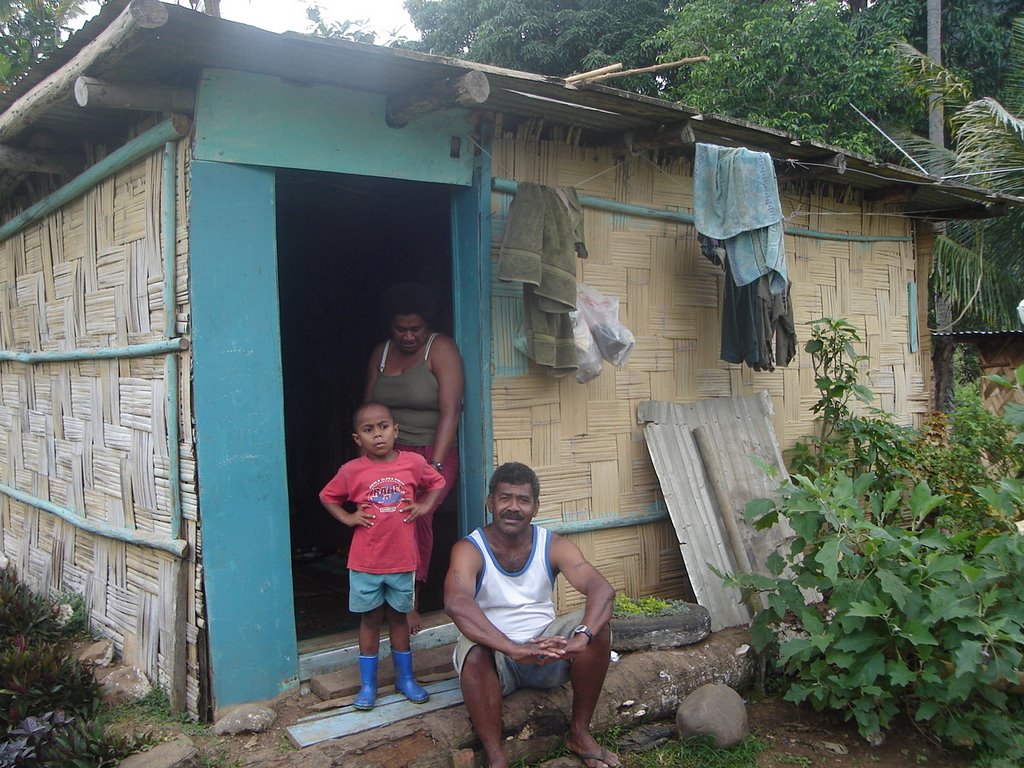
note: This is my house in Abaca, Fiji.
Saturday, November 04, 2006
Fiji
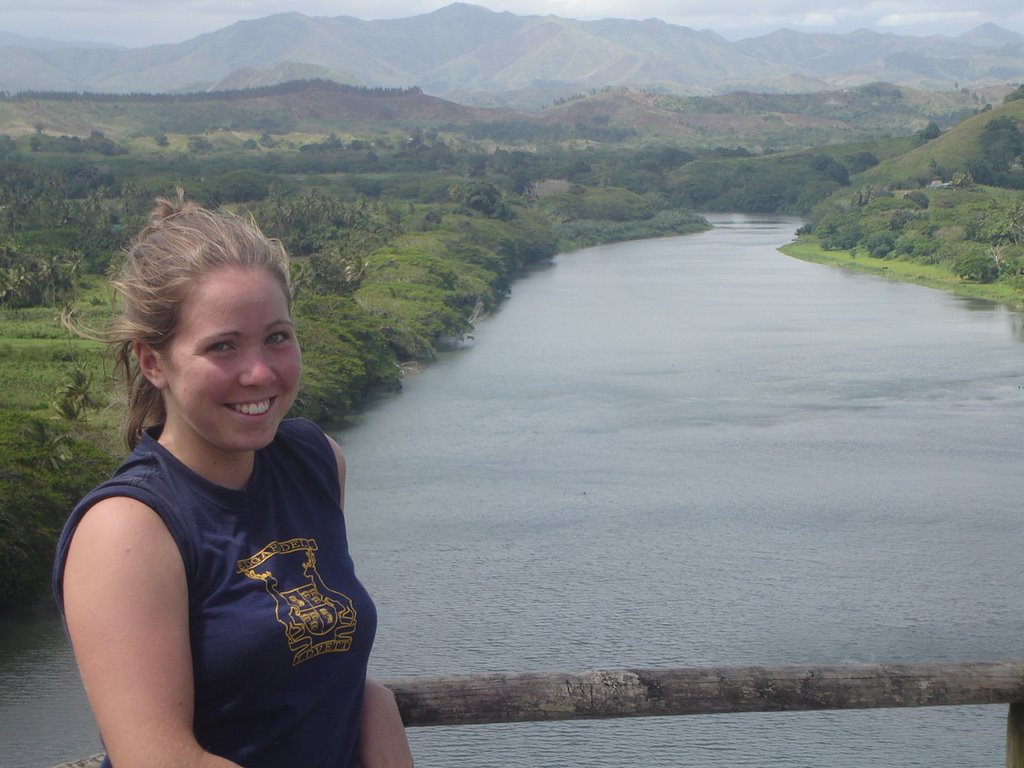
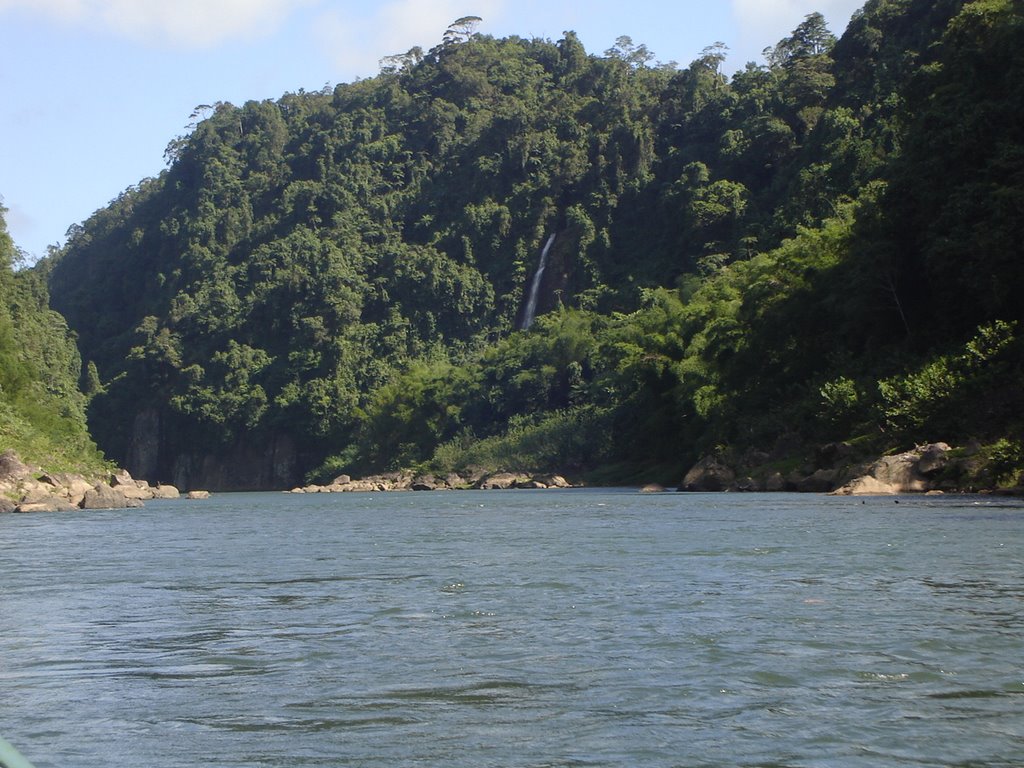
I am in love. Samoa is beautiful and amazing, but Fiji- well, no wonder it's such a hot spot for tourists. We spent about a week there and I would really like to go back at some point in the future. I'm not really sure how long exactly because it's all so confusing crossing the international date line twice. It was kind of cool. First we didn't have a Saturday, and right now I'm in the middle of my second straight Saturday. I don't know about you but I think it's pretty cool to have a second chance at Saturday...especially since we spent Saturday evening on a bus. Of course, Saturday morning was pretty awesome. We went down a river to an eco-tourist village and then up to a waterfall. The river ride was really pretty. The whole time I kept thinking to myself "This is how I would have imagined a river in China." The tourist village was interesting because we haven't really seen a lot of the commercialization of culture for tourism. We've seen culture manipulated for us when we've been hosted by families, but it was still different from the ceremony that was present in this village. It was nice because they explained some things better, but I am glad that we have been able to experience a little bit more of the "living" culture...the way things are done now.
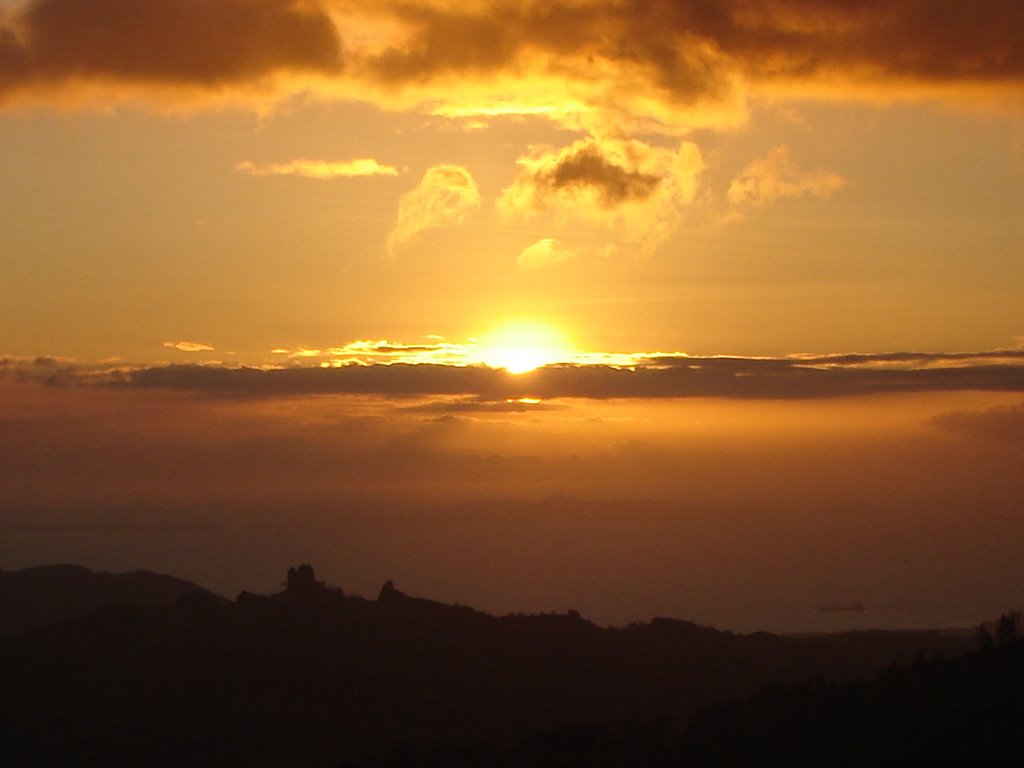
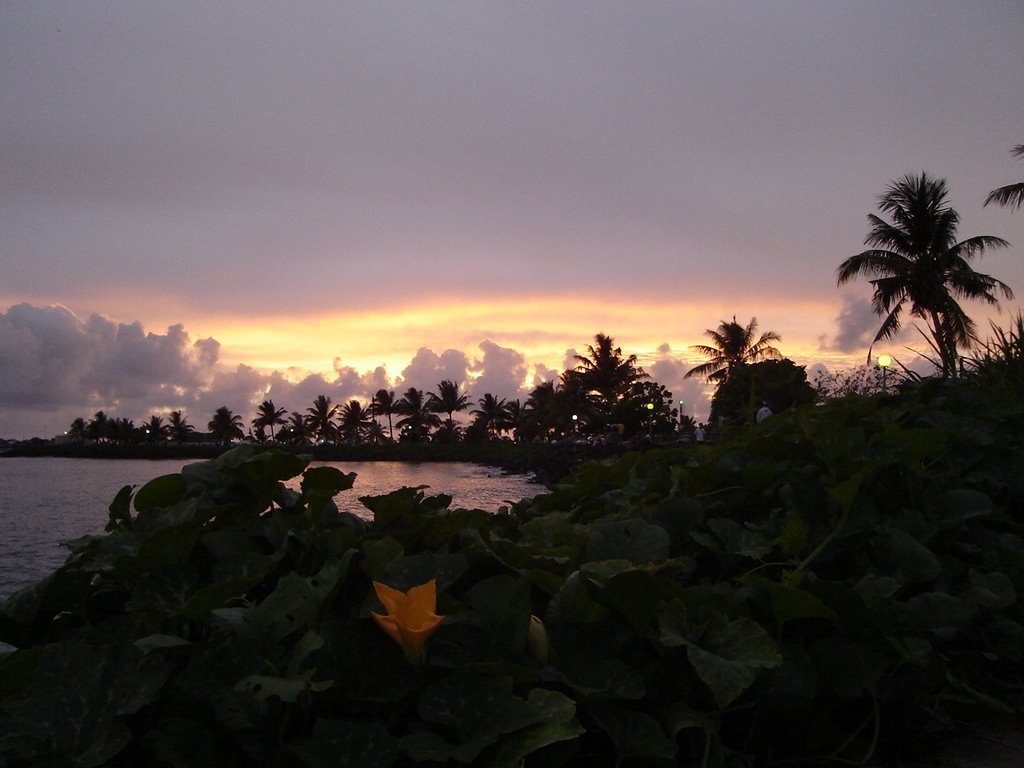
Sunsets in Fiji are beautiful...as are sunrises. On the flight over we saw the sunrise out the window of the plane. It was so amazing, and really cool to think about as well. I mean, I was leaving Friday and entering Sunday morning in a plane over the ocean watching the sunrise in first place on earth. What more could I ask! We also saw a few sunsets. My favorite by far was the one in Abaca- a small village of 80 people where we spent our first couple nights with host families. There is no electricity and its far removed from pretty much anywhere else. They cooked completely by fire, and at night the houses were lit with kerosene lamps. On the one hand parts of Fiji are extremely developed, but on the other you have this remoteness that is even greater than that of Samoa. The first night we were there we hiked up to a nearby hill and watched the sunset over the ocean from the hilltop. I dont even know how to describe it. As one girl in our group put it "I feel like I've seen Paradise." Sunsets on the beach are amazing, but watching the sunset behind another island on the horizen from 1500 feet is a completely different experience. All I could think of was wow...and God created this for me. How you can not believe in the Almighty after seeing something like that I dont know.
The next day we went up to the top of the second highest mountain on the island at 3600 feet. The hike was pretty intense, I'm not going to lie. Only a few of us went. There were some parts where it pretty much just went up- none of this cutback that you find in so many national parks. Once we got to the top it was another wow. We were so high- I almost felt like I should be able to reach out and touch the clouds. If you're wondering what the view was like go back and watch Lord of the Rings. It wasnt filmed here but the scenary is very similar.
Most of the rest of the time we spent in Suva studying at USP main campus. For many people in my group it was somewhat of a reverse culture shock. I think Suva is something like 79,000 people. It's good sized. It's full of life and motion and cars. Lots of people. I loved it. We met up with SIT Fiji and hung out with them a little. It was nice to have some people who knew the city and where to go and what to do. I've loved Samoa, but part of me wishes I'd gone to Fiji instead. It would have been a very different experience. I guess I'll just have to go back later eh?
I feel like I haven't said a lot, but I feel like thats also because I'm still trying to process all of it. The village life was so different from Samoa. People seem to be more relaxed. There's more of a sense of privacy it seemed, and people actually locked their doors. Guys aren't as agressive which made me happy. They drink more ava, and seem to have more dancing and singing. Suva is huge in comparison to anything in Samoa, so it was interesting to see the direction that development has taken Fiji. Oh, and bartering. I had to try it because in Samoa you don't.
I just realized that I completely forgot to talk about the Halloween party. We were in Fiji and didn't really know our way around at all. SIT Fiji had a lot of work due when we first got there so we were pretty much on our own. Most of us made costumes using what we had. We had a gangsta', "white trash," a bellydancer, a student, and I was a snorkler. However, and this was what made the party- a few of the students had bought superhero costumes in American Samoa. Unforunately they were only available in kids large so three boys were crammed into this much too small for them spandexy like costumes. One of the girls also had one, but it actually fit her and looked cute on her. I wish my pictures had turned out better because they were hilarious. Two of the boys actually went out in their costumes later that night...
Friday, October 27, 2006
New pictures
I didnt quite succeed in my mission, which was to add photos to all of my posts, but I did manage to get quite a few uploaded. I have to go change now...there is a farewell ball tonight.
The cow jumped over the fence
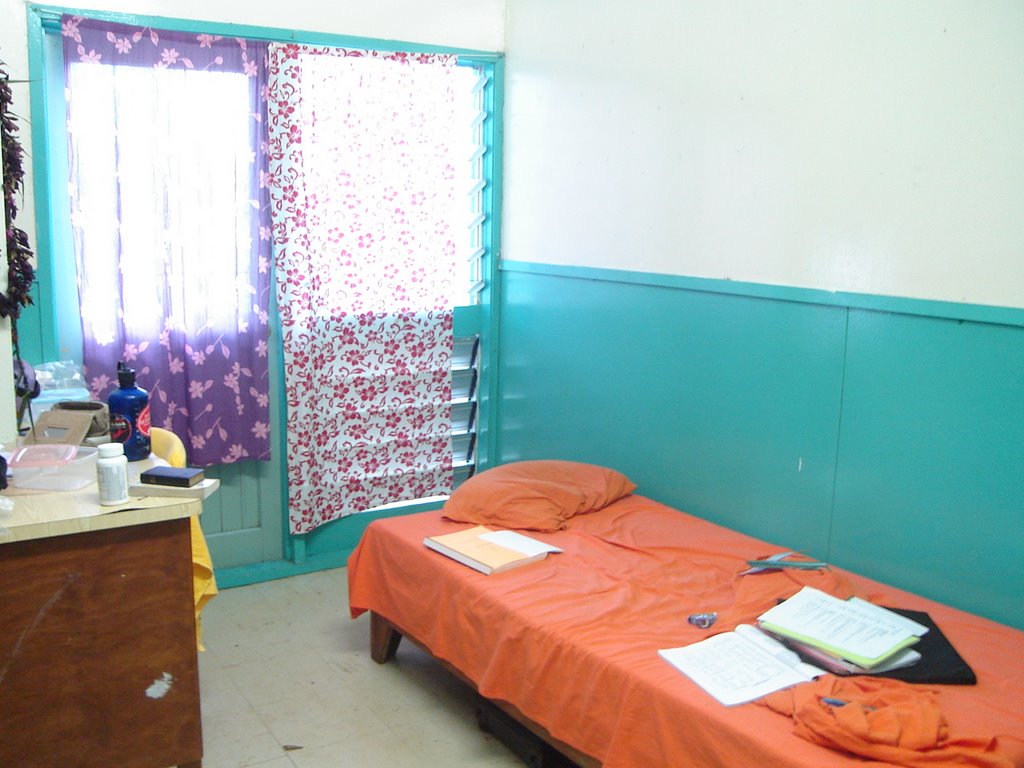
Yesterday was pretty much a continuation of lots and lots of rain. I’m beginning to miss the sun. Apparently last semester there were three solid weeks at the beginning when you never saw the sun at all because it was raining non-stop. No wonder there were so many problems…
To make up for the fact that the rain pretty much kept us in our rooms my roommate and I have begin reading Harry Potter out loud to each other. I’ve never read the books and even now that I am I don’t really see what has caused all the hype. I’m actually quite critical of them and think Harry Potter is a spoiled little brat. I much prefer Artimus Fowl. Reading them has been something to do however when its raining outside and there is no one else around. I don’t remember if I mentioned this or not but the rest of our housemates were moved to other houses last week due to “continued breaking of the rules.” Apparently there were a lot of drunken parties when we weren’t around on weekend, plus there were other issues with rule breakage. I do miss them. All three were from Fiji and it was nice to come back from our travels and know that they would be chilling in the commons watching TV or movies. Now that they are gone our house feels so empty. But back to reading Harry Potter. We sit on the bed, make tea or milo, and eat biscuits while we take turns reading chapters. We’ve about a third of the way through the book.
Last night after reading a few chapters I went back to my room to finish up a few assignments. I was sitting at my desk when I heard a rather loud noise. “Those stupid dogs I thought…boy are they loud tonight.” Next thing I know Kalia was in my room: “Did you just see that cow run by your window?” Yeah I felt just a tad bit stupid. I mean I knew that was a cow noise. I don’t know why I thought it was the dogs. But yep, right outside our door was a huge cowing mooing and groaning and making all sorts of loud noises…at 11:30pm! We debated whether or not to call someone when we saw flashlights approaching in the distance. The security guards tried to move the cow but were successful only in emitting more cow-like noises from the animal. Kalia and I were doubled over in laughter in our house. The whole situation was just so bizarre…especially as it was happening in the rain. I think the security guards heard us because they promptly began laughing at us. I guess that’s the way things go here.
Tomorrow morning, at 2:30am we leave for Fiji. We’ll be gone for a week I believe, but I’m somewhat confused as to the actual time we will spend in Fiji as flying there involves crossing the international date line. We leave Saturday and arrive one hour later on Sunday. I might actually have internet access there since its supposedly more developed but I cant promise anything. Immediately after I finish here I’ll be going to class where each of us will be giving a five-minute presentation on some aspect of Fiji. I’m doing politics and the coup. I’m still trying to figure out how I’ll squeeze that into five minutes as there is quite a bit surrounding that issue. A lot of it has to do with racial tensions between Native Fijians and Indo-Fijians who were moved to Fiji as part of the British colonization of the island to work on the plantations. The other big issue, considered by the Fijians I spoke with to be the biggest issue, involves the land. 80% of the land is currently communal land, with leases that used to last 99 years. As a result of the tension leases have been changed to 30 years, with the result that when many of the Indo-Fijians (who are the ones leasing the land since they cannot own it as non-natives) leases expire the native Fijians are refusing to renew them. Both the Indo-Fijians and the natives recognize this as a problem, at least from an economic standpoint. The Indo-Fijians are the ones who have been developing the land for the past hundred years. As the natives try to move back in, they are finding that they do not know how to get the same amount of yield from the land- whether that is from a lack of experience or a different work ethic depends on who you speak to. But that’s a basic background of the issue. And now off to class.
Wednesday, October 25, 2006
Culture
What is culture? How do you define it? Our discussion today focused on changes within the Samoan culture, but reading through the articles I couldn’t help but wonder. What is it that makes one people different from another? Is it even possible to put your finger on the differences? Or can you only see the outward manifestations? How do you map the changes in a culture? I’ve spoken so much about American culture and Western culture and Samoan culture and Catholic culture. But what do those really mean? Culture deals with people- and people are so individual, how do you group them all into one. These are questions that are so hard for me to answer right now. It’s easier to just absorb and do then it is to contemplate and try and understand sometimes.
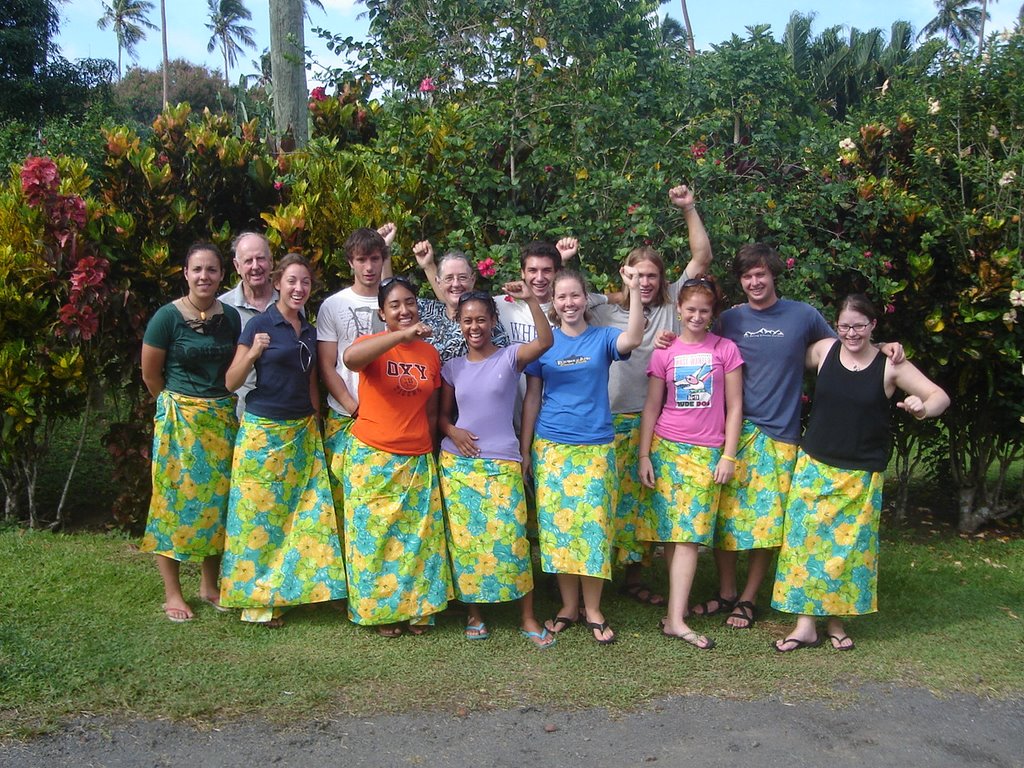
Speaking of people, I’ve been asked about the other members of my group. As I may or may not have mentioned earlier there are currently eleven of us in the program. They come from around the country and everyone is from a different school. I’m the only economics major. Most of the others are sociology or anthropology majors although there is a linguist and maybe history major as well. You’d think I’d know better but we’ve all been taking the exact same classes for the past two months. The only thing that will be different is our research, but even that will sometimes be hard to tie directly back to what they are studying back home. The topics are also quite varied: effects of Westernization on the language, remittances, waste management, the church, discipline, views on death, composting toilets, small village stores, land tenure, alcohol/clubs, and of course alternative energy. The reasons for coming are also quite varied. Some are here because they have always been interested in Samoan culture or because it provides a really great place for them to do original research in their field. Others are here most because it just seemed like a cool place to go and it fit in with their school schedules. There’s even a guy who came because his ancestors were missionaries in the Pacific. Overall I think we have a really varied and well-rounded group. According to our Academic Director we are also one of the better groups she’s ever had. We’ve told her she should consider retiring after us because we will be impossible to follow.
Tuesday, October 24, 2006
Tourism
Today our discussion focused on tourism. We had to read two articles by Hawaiian authors who were quite passionately against tourism. I don’t know that I would agree with everything they said, but having been to Hawaii and seen Waikiki I can’t help but sympathize with some of their points. Over six million people swarm the Hawaiian Islands every year, far in excess of the total population of the islands. They create such a drain on resources and have had quite a devastating effect on the cultural. I know that I personally had not thought much of the cultural heritage of Hawaiians before this semester.
The discussion of Hawaiian tourism led into a discussion on Samoan tourism. Samoan tourism is much smaller. There were slightly over 100,000 visitors last year, with 40% of them being returning Samoans. Samoa is also one of the few Pacific Islands nations with an almost 100% locally owned and operated tourism industry. I personally think its better that way. If control of the industry remains in the hands of locals it will develop at a sustainable pace and not come into such intense conflict with local culture.
I really liked staying in the tourist hotels in Savaii, especially the beach fales. There was no hot water. We slept on mattresses on the floor. There were no real walls, no fans, no TV, and only communal bathrooms. But there was a sense of community. We met the family who owned the fales. We ate dinner as a group with the other tourists. It was a very different environment and one which I feel a big foreign-owned hotel would not be able to duplicate.
Monday, October 23, 2006
American Samoa
American Samoa. A much smaller, more mountainous group of islands that is now a US Territory. Back in the day its main asset was the deep and well protected harbor of Tutuila. We spent four short days there, and it is still a challenge to decide what to say about it.
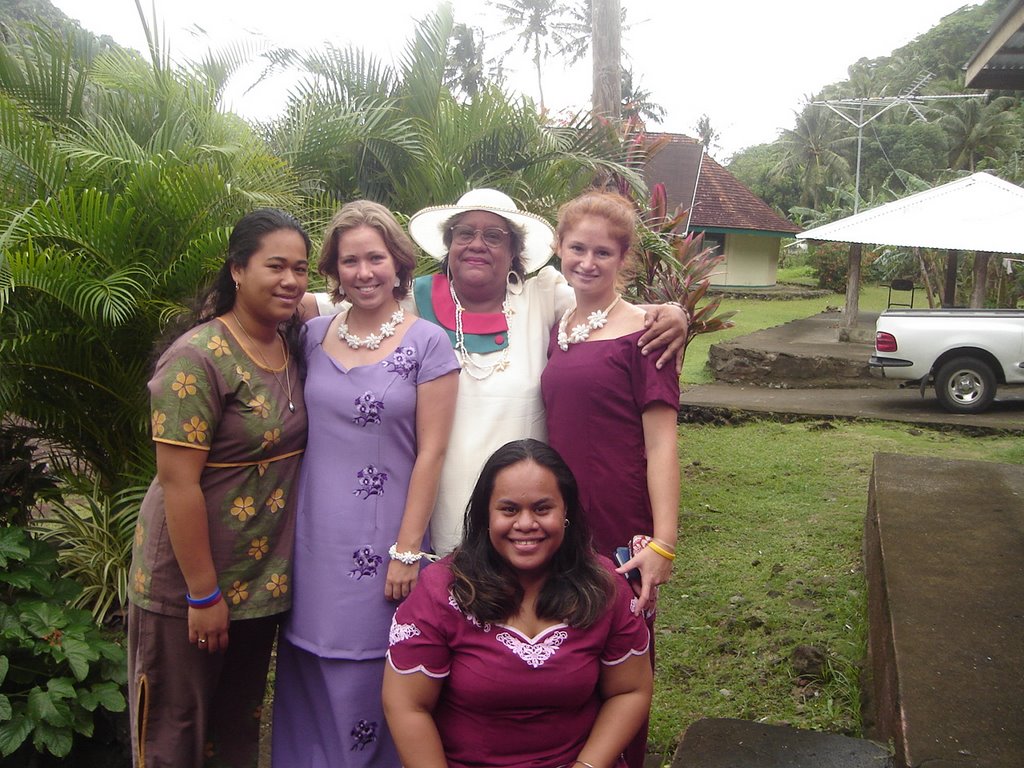
I’ll start with our activities there. We flew out from Upolu at 7:30 on Thursday morning on a little prop plane. My perception of things must be changing because it was actually comfort to know that we were going on the “big” plane as opposed to the 15-passanger plane that we used to fly across the ocean the last time. After breakfast and a tour of Pago Pago we drove to American Samoa Community College, the institution that would be hosting us for the weekend. We met our host students and then had a chance to attend part of their YANA (You Are Not Alone) 3rd year anniversary celebration. YANA is an organization that started after three students committed suicide in one year. More on that later. After lunch we had an art class. I must admit that after sitting in lectures for hours on end painting cloth and making siapo bookmarks was a welcome relief. We spent the evenings with our host families. Friday morning we watched a film on a man who tries to bridge the gap between being a Samoan and an American. The man who produced the film was actually our host so we had a discussion with him afterwards which was very enlightening. Our next lecture was by Sia Figiel, one of the foremost Pacific authors. I think it’s always a great opportunity to be able to meet with authors, especially when they are as entertaining as Sia was. Saturday the entire group, SIT students and hosts, hiked up to the Mt. Alava and then down the other side to the ocean. Let me just say now the view from the top is amazing- even though it was cloudy and rainy. It’s, I believe, the highest point on the island and looking down you can see the wharf and main town areas. It was incredible. The hike was a lot of fun as well, especially the one on the way down where we had to use ladders and the ground was slippery and muddy from the rain. We went in two groups. The first group made it to the top and down in under four hours. We then sat and waited another three hours for the second group to emerge from the mountain literally covered in mud. It was quite a sight to behold. I wish I had more time to describe the hilarity and awesomeness of the hike, but I think that’s one story you’ll just have to ask me about when I get home. Sunday was pretty cut and dried. We went to church, had to’ona’i, did a little shopping, and then headed home. I was exhausted by the time I got back and couldn’t wait to crawl into bed.
Now to the fun part…trying to describe American Samoa. As I mentioned earlier it’s much more mountainous than Western Samoa. It’s also much smaller and the beaches aren’t quite as nice. So much for the description of the land itself. Relatively easy compared to the rest.
Aside from the geography, American Samoa is also very different in other aspects of its physical appearance. For one, it is more developed due to all the aid that comes from the US government. There are more cars, more buildings, a very smelly tuna cannery, a bigger wharf, more American restaurants, nice houses. However, with all of this also comes more junk and more outward appearances of poverty. It’s easy to forget that Samoa is poor because it doesn’t have the same look that is so often associated with poverty in rural America. That is not the case in American Samoa. Another thing that really struck me was all the billboards. They weren’t tall and they didn’t scream out advertisements for everything you could imagine. They were at eye level and had messages about drugs, smoking, teenage pregnancy, and early childhood immunization. Another difference in physical appearances was that of the Samoans themselves. One of my sisters had asked me in an email if Samoans were rather large. My response was not particularly. I mean they aren’t. Most of the younger guys here are actually quite ripped. They might have a little bigger bones and be a little taller but I wouldn’t call the majority of the younger people here overweight by any means. It’s becoming a problem, but I didn’t really see a major difference with the US. That is not the case in American Samoa. There, the Samoans were big. Very big. Why? I’m not quite sure. Maybe its all the processed food, maybe its that they don’t work on the plantations as much as they do here. I don’t know the reason. All I know is what I saw.
Culturally and socially there were also some differences, but this is where I begin to have problems. Some things were the same- the respect, the openness with which my host family received me, the extreme hospitality and generosity, the closeness of family ties, the importance of religion (at least in my family). Those things were the same. Others were different. My first night there I had a long talk with the girl who was hosting me about suicide, and family problems, and life choices that many young people are facing. It was a very heavy conversation and I couldn’t help but think that the issues being faced there today are very similar to those being faced by many inner-city youth today in America. It was not easy and I think that is one reason I have having such a hard time sorting through this in my head. I know some of those issues are being faced here, but to this extent? How much an influence has Westernization had on this culture? How much of it has been good and how much has been negative? How do you solve some of the problems that have been created?
Don’t get me wrong. My experience was amazing. My family did everything they could to show me the differences between the way things used to be and the way they are now. The first two nights I showered outside in the middle of the school yard and ate outside with the parents sitting on the ground. The last two days we used the indoor bathroom and ate at the kitchen table. We watched football and I was actually allowed to help cook- things that never happened in the village in Western Samoa. If I could, I would have stayed another week. I think I could safely say that it has been my favorite home stay to date.
And now I think I’ve rambled enough so I will end this post. I’ll share more later this week. J
Wednesday, October 18, 2006
Impossible to miss
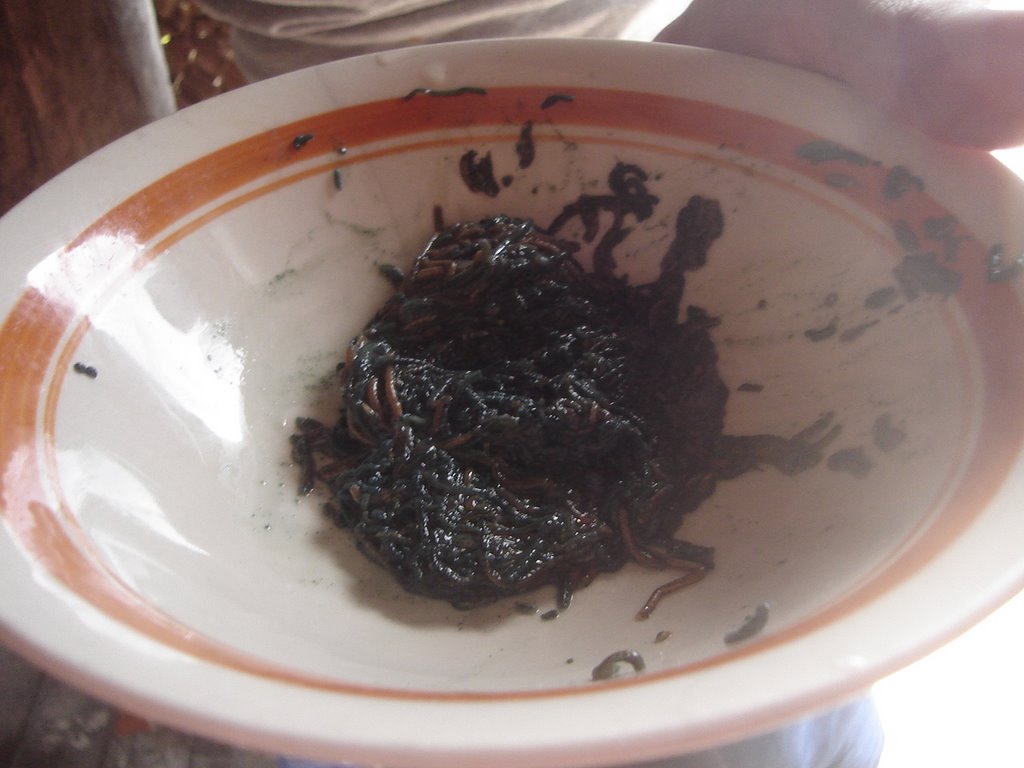
Last night as I was talking with some of my fellow SIT students I realized that I had forgotten to tell you about a very important part of our Savaii trip. At 4:30am on Thursday morning we woke up and walked about ½ a mile down the beach. Out in the water we saw what looked like a bunch of big stones. As we approached them they took on human form. We were in the right place! For the next hour we used pieces of mosquito netting strung on a stick to scoop black and brown moving strands of angel hair spaghetti into a big red plastic bucket. Once the sun came up the spaghetti strands began to disintegrate on contact and it was time for us to return back to the fales- but not before we took turns tasting the squiggly things we’d just caught. We took our catch to the kitchen and asked them to prepare it for us for breakfast. Cooked they were a darker green. They still retained some of their salt water taste, but were quite good on toast. For dinner again we ate more, this time prepare with eggs and onions. I liked the dinner version better.
And now you ask- what exactly were you eating? A Samoan delicacy. It is catchable only one night out of the year in the hours right before the sunrise. There are only a few locations where it can be found and people come from around the islands to catch and eat it. The small handful that we caught would probably make WS$30 in the market. It’s called Palolo. What is that? Do you really want to know? It’s the reproductive organs of a certain kind of coral worm. See! I warned you! It’s really not that bad and it was one adventure I was certainly not going to miss. When else would I get another chance to try it?
Tuesday, October 17, 2006
Academics
I almost didn't update today. After the excitement of last week not very much happened in the past 24 hours. That and I have a presentation tomorrow so that's kept my pretty busy. So, instead of actually trying to come up with something creative or interesting I decided to copy and paste from an email I just sent a friend from college. Yeah I know- boring but hey...its better than nothing. :)
We had our language exam today. It's a relief to have that out of the way. I've enjoyed learning another language-dont get me wrong but at times it also feels so pointless since so many people speak English. It makes it so much more difficult to learn it on the street. Being done with language means that I only have two classes left. One is a seminar on Pacific culture, and the other is my research project. The seminar class has actually proven to be quite interesting. All of our lecturers have been very knowledgeable in their fields, and we've covered a variety of topics. In the beginning we were learning things about the Samoan way of life, the rule of law, the role of the church, economics, etc. This month we've moved into the traveling part and so it's become more of a comparison of cultures. The lectures in Savaii were mostly geological in nature, and in Fiji I think we'll be looking at the effects of tourism. It's been interesting, but I must admit I wish there wasn't going to be a test at the end. As for my research project- I'm doing that on renewable energy development in Samoa, more specifically the use of solar. It's coming down to the point where I need to actually define my topic and draw up an outline. As of right now I'm thinking of looking first at the philosophy behind electric development because it's really not based on economics. I read through one of the proposals and under the financial analysis it basically said yeah we aren't doing one because it would be pointless. I think it'll also be interesting to research because there is next to nothing in written form about the subject, which means that whatever I do will be based on interviews. For the second part I'll hopefully be working with the electric company to actually look at the feasibility of using solar panels to power one of the few places in the country that is currently not connected to the grid. This would be my opportunity to actually run the numbers and do some economics, plus it would actually benefit the company. In return I think they might be taking me out to visit one of the smaller islands. So that's pretty much where I am now in terms of academics.
Monday, October 16, 2006
Bark cloth
After using the computer at the internet café in Apia earlier today the snail-like speed of the internet at USP is really frustrating me. I’m finding it impossible to even send an email. As my research project heats up I’ll probably be spending more time there doing using the computers/internet. Before that happens though we have two more trips planned. A short four day visit to American Samoa and a week long visit to Fiji. I’m feeling a little spoiled right now.
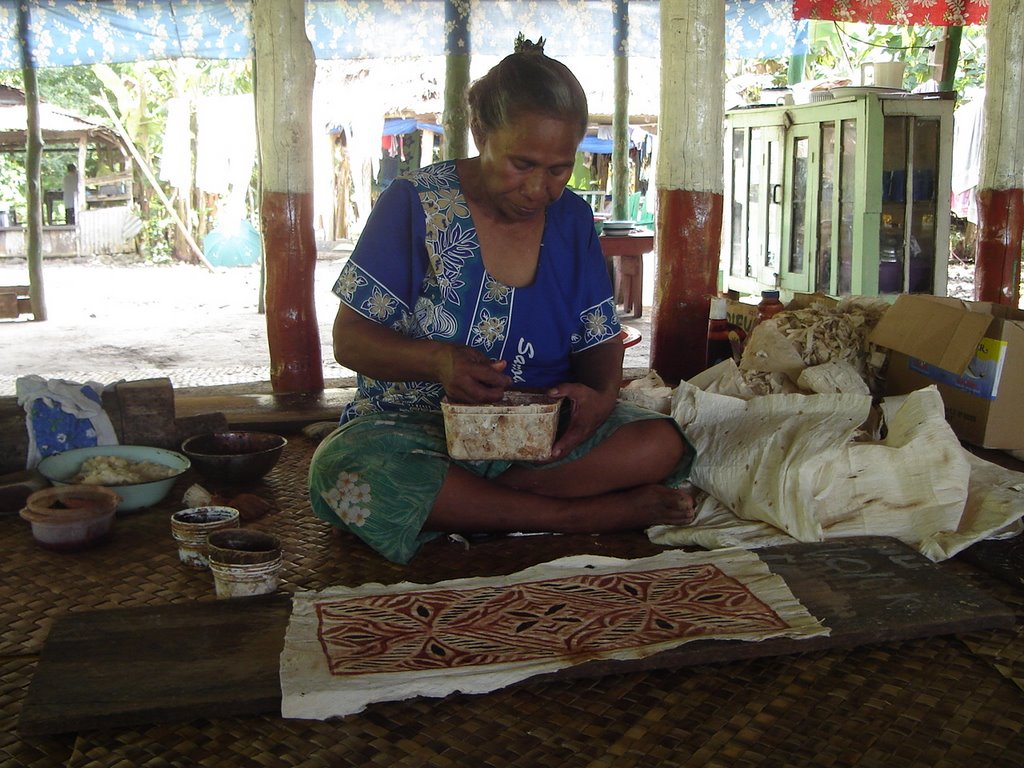
I realized on the way into town today that I’d completely neglected to talk about one of the activities that occupied our time in Savaii. On Wednesday morning we made Siapo or bark cloth. Talk about labor intensive! The technique and the tree used both came from China. I don’t remember the name, but it’s a very thin tree, maybe an inch in diameter with few branches. The bark is stripped from the tree, which is easier than it sounds. A small slit is cut at one end and then the bark just peels right off the tree. That’s the easy part. Next, the inner bark is separated from the outer bark. That part is harder than it looks. What you’re left with is a thin, sticky, but long piece of white inner bark. The next step in the process is to remove the glue that holds the bark fibers together. This is done by scraping the bark with a seashell over and over and over again. When the stickiness is gone the pounding commences. What began as two inches wide will become a foot wide due to the repeated pounding of the bark over a piece of hard wood. Once the bark is pounded it is stretched out in the sun to dry without losing its shape. The rest of the process is fairly easy in comparison. Dry pieces are pained and glued together using a starchy paste made from cassava (a root). The paint is made from the die of another tree’s bark and is heightened by the use of red clay. Traditionally the back cloth was used for ceremonial purposes- wedding garments and dance costumes. Today you can buy small pieces in the market to bring home as souvenirs. I got to make my own small piece to bring back. While I didn’t make mine from start to finish I was able to try out the entire process. Trust me, its very labor intensive and time consuming. Hopefully I’ll be able to show you what I made, but as of right now there has been a slight mix up and we aren’t 100% sure of where exactly our siapo is at the moment.
Back from Savaii
I’m back from Savaii, and what a week it was! It’ll probably go down as one of my favorites of the entire program. It felt almost like we were on vacation except for the few assignments we had due while we were there. We toured around the island with a 75-year geologist from Australia. He reminded me a little bit of my grandfather, and I know that if he had been there they would have had some pretty intense rock discussions. I think Warren, our guide, was a little disappointed that none of us knew anything about rocks.
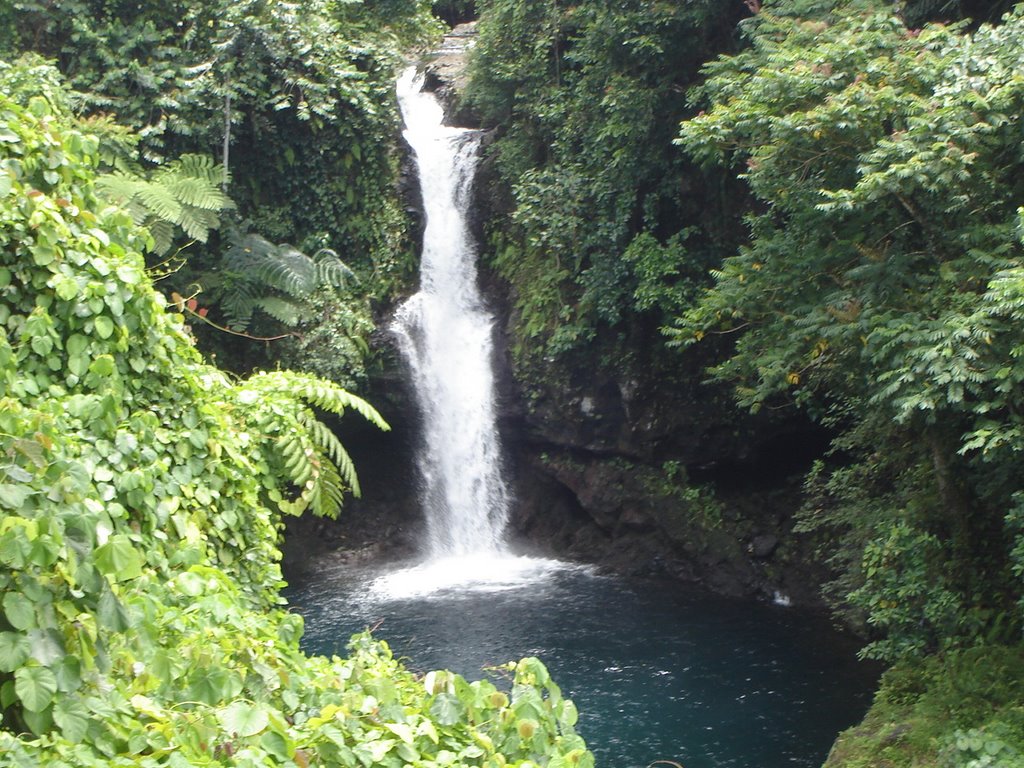
We visited the largest ancient known Polynesian rock mound. They have some idea of when it was build, but no clue as to why. Perhaps human sacrifice? Maybe for pigeon hunting? They just don’t know. A short hike away was a 45ftish tall waterfall with a beautiful clear water hole that was used as a swimming hole. Jumping through a waterfall is a lot of fun! We also visited some blowholes, did a cliff walk, hiked a mile through lava fields, and saw some other random touristy things.
Thursday we moved from the hotel where we’d been staying to some fales on the northern side of the island. Talk about amazing! We were right on a beautiful sandy beach, but without the swarms of tourists that we see so often in the states. It took thirty seconds to go from my fale to the water. Needless to say I spent quite a bit of my spare time snorkeling or just relaxing under a palm tree.
Saturday was possibly one of my favorite days. In the morning a small group of us hiked up to the dwarves cave. It’s a huge lava tube of undetermined length, but legend has it that a group of small people once inhabited it. A man found them while hunting and in return for keeping their location a secret granted him all his wished and made him a wealthy man. Unfortunately he did not keep his secret forever and several years later shared the location. When others from his village went to investigated they found no one there, and when they returned to the village all the man’s possessions have disappeared. Perhaps the magical dwarves are still down there, far far underground where no one else has explored. Going through this cave was something else! There was a very small, maybe 4 ft in diameter opening, but then once you got inside it was easily 9 ft high and fairly wide. We had three lights between the five of us and our guide so you can imagine how dark it was. We had no idea where we were going. At one point the path dropped into a pool of water and our guide told us we would be going down and then swimming across to get to the other side. We looked at each other and just went ummm…. It was unreal. You would never get to do something like that in the states. There would be all sorts of warnings and handrails and protections in place. But it was so much fun! We spent a few hours with our guide and afterwards he climbed a coconut tree and got us something to drink. The craziest part is that at the very end after we’d been invited to come back and spend a few days with his family we found out that he was our language teacher’s brother.
Later that evening, right before sunset I managed to get two of the people who hadn’t come on the hike to go kayaking in the ocean with me. Everyone else was too tired. Me? I was so pumped. We were out in the water for about an hour and let me just say that riding those waves was a blast! I would love to go again! I’ll admit I took a few tumbles and lost my kayak at one point but catching some of those bigger waves was such an adrenaline rush!
Sunday we came back to Alafua. This time the hour long ferry ride was full of people coming back for work and school on Monday. Samoans are generally laid back until it comes to transportation. I’ve never seen such a mad dash for a small opening. As several others mentioned- its worse than the subways of NYC if you can believe that. I’ll have to leave the full description of the ferry for later however as I have class very soon.
Friday, October 06, 2006
Making my day
I just got back from the hospital and visiting Kati. It’s pretty much official. She’ll be leaving to go home next week. It’s hard to believe. A small cut and now she’s looking at having to get skin grafts to repair some of the damage caused by the bursting blisters. The culture came back today as a staph infection. Apparently 90% of Samoans are carriers of the bacteria which explains why it was so puzzling to us. I’m planning to go into Apia tomorrow to do some gift shopping for Kati since she won’t be able to now.
I think I’ve mentioned the incredibly friendliness of Samoans, but I have two more examples. After leaving the hospital I began walking back down towards Apia. I figured that if I had to wait for the bus I might as well get some exercise at the same time. Several minutes later a taxi pulled up beside me and the woman in the passenger seat asked me where I was headed. I replied Apia and she offered to let me ride with them. Turns out the lady works at Med Cen (the private hospital where Kati is staying) and she and her husband were on their way into town to do laundry. She’d been working last night and I guess recognized me.
The second example involves my research. Last fall one of the boys on the program had worked with someone at SPREP on a project involving climate change. Jackie recommended that I contact him to see if he couple at least help point me in the right direction. Despite the fact that alternative energy is not his field at all he has done so much to help me. He has provided me with names and contact information, and invited me to come by his office anytime. Since it’s only a five minute walk from the hospital I scheduled a meeting for today. We talked for about an hour and he gave me all sorts of tips and pointers, offered to dig up some reports for me that I would probably not have access to otherwise, gave me some more names, showed me around the office, and then drove me by the store to pick up some of the most delicious apples I’ve ever had (they were for Kati but I bought one for myself as well), and then to the hospital. He went out of his way so much. I was amazed. He has to be busy, but he was so willing to help a student. I think back in America it would be incredibly hard to get the kind of access that is, I fear, going to become second nature to me before I leave.
Tonight is the talent show. Wish us luck! We have to perform our dance again.
Laziness
I have no real excuse for not updating yesterday except for that I was feeling rather lazy. I spent a lot of time in the computer lab yesterday because we had our first paper due today. Yeah no big deal, but most people in the group seemed to be stressing a little bit too much about it. I did mine on solar power in Samoa and some of the challenges that face small island nations. For example, even though it is good in theory the technical expertise to service projects is not always available. Also, even though villagers want the services provided they do not always provide the necessary maintenance to ensure long-term project success. I don’t think this is something that is completely unique to Pacific Island countries, it just so happens that the resources and funds to designate someone else to care for the project are not available as they are in other countries. The second part of my paper focused very briefly on the solar project on the island of Apolima.
I spent last night at the hospital with Kati. We’ve been taking turns sleeping there so she isn’t there alone and last night I volunteered since my paper was almost finished. It’s so bizarre. The doctor is not completely sure what it is- possible an infection right below her skin. It had looked so much better when I went to visit her two days ago, but last night the redness was back. There was talk last night of med-evacing her to the United States because it might be a prolonged recovery. That way she would at least be with her family. Jackie is obviously disturbed by the suggestion. This is the first time in ten years anything like this has ever happened. I think it’s confusing a lot of people right now. I hope she gets better. We all miss her.
Also, another heads up. Saturday morning we leave for Lotofaga for White Sunday. We come back Sunday afternoon but turn around Monday and go to Savaii for a week. Once again, internet might be non-existent so don’t panic if you don’t hear from me for a little while. I will return!
Thursday, October 05, 2006
Education in Samoa

Today was very long. I spent last night with one of the Samoan students at her sister’s house so we had to wake up at 6am to catch the bus to Apia and then another bus from Apia to Alafua. Instead of meeting at 8am as on most mornings we were meeting at 7:30 because we were going to visit several schools and wanted to see assembly for the first one.
Our first school was Don Bosco, an all-boys vocational school located about a mile away from the USP campus. It is run by the Salasian Priests and has a current enrollment of around 250. The boys range in age from 16-21. I’ll be honest. Visiting did a lot to restore my faith in religion here in Samoa. I’ve spent the last couple weeks seeing a lot of the financial corruption of religion here and it had left me wondering- where are the Catholic priests? What happened to the missionary spirit that so inspired me when I read the stories of the Jesuits who came to North America? Do people actually believe what they are preaching here? What I saw today convinced me that yes, the Catholic Church is still very much alive here and interested in helping the people of Samoa. I’m sure you know the story of Don Bosco. He founded an oratory to help trouble boys; to give them something to do and take them off the streets. This school fulfills much of the same purpose. In the 1980’s the Catholic Church did a survey in the country to see what needs were not being met and they realized that large numbers of boys were dropping out of secondary school which was really limiting their ability to get a job. In 1989 (?) Don Bosco Vocational school was opened to train young men and give them the technical skills necessary to obtain jobs. I finally saw what I wanted to see here in religion. A place where ability to pay is not an issue. Term tuition is WS$130 or approximately US$50, but even that is too much of a financial burden for some students. Rather than turn the away the boys work for a few hours on Saturdays at the school to earn their tuition. As a side note, all of the other religious groups in Samoa have followed the Catholic’s lead and now have technical schools of their own. We spent about an hour and a half at the school. The first half was spent observing assembly. They sang for us which was great because they won the Teuila Festival competition so many years in a row they have been dis-invited. In other words, they are pretty darn good. Father also gave a speech in which he thanked us for coming, especially since we brought so many girls. I don’t think everyone else in the group found it as amusing as I did. After the assembly we toured the workshops- a mechanic shop, work working, and metal.
After Don Bosco we went back towards Apia to visit a special needs school. They mainly deal with deaf students, but there are also some other physically handicapped students. Once again, most of the money for the school comes from private or overseas sponsorship. Another interesting thing to note is that there is no Samoan sign language so they use Australia’s. That means that in order to translate they must first go from Samoan to English to sign. Very complicated. Also, sign language was not introduced into the country until the 1980’s. Most people still communicate using their own personal language. Jackie also mentioned that there seems to be a disproportionate number of deaf people in Samoa. Is there a reason for that?
Our final visit of the morning was to NUS- National University of Samoa where we had a lecture on education in Samoa. I wish I hadn’t been so tired because I might have gotten more out of it. I was just wishing that the next door neighbor’s baby had cried all night. :-P
The afternoon was spent doing research. I went back by EPC and talked to the head engineer. I have a very good chance of being able to go to the island of Apolima in November. I really hope it works out because it’s a very hard island to access. I think I also have a much better idea as to what my research will cover- which is always a good thing. My meeting at EPC finished early so I had about an hour to kill before the research center at SPREP opened. I knew it was straight up the road but wasn’t sure how far away it was so I decided to start walking and catch the first Vailima bus that I saw. Many busses passed by, but not a single one said Vailima. I walked for just under an hour and still no bus. By that time though it didn’t matter because I was where I wanted to be. My best guess is that I walked about four miles. Nice little walk. On the way back I caught the bus, but not before stopping by the hospital to say hi to Kate (whose foot is looking ever so much better) and leaving my nalgene at a corner store (that makes me very sad.)
And now, off to do some more research.

Subscribe to:
Posts (Atom)