Thursday, October 05, 2006

In search of the perfect cone


Last Sunday after another ice cream cone from McDonald’s I decided to make it my mission to find the best ice cream in Apia. I tried two places today- a little road side stand, and Lily’s Cakes and Cones. I think Lily’s might be my favorite so far, and after being disappointed in the road side stand I think I might very well stick with Lily’s and this grocery store stand that also has some pretty decent ice cream. In other words, my quest didn’t last too long.

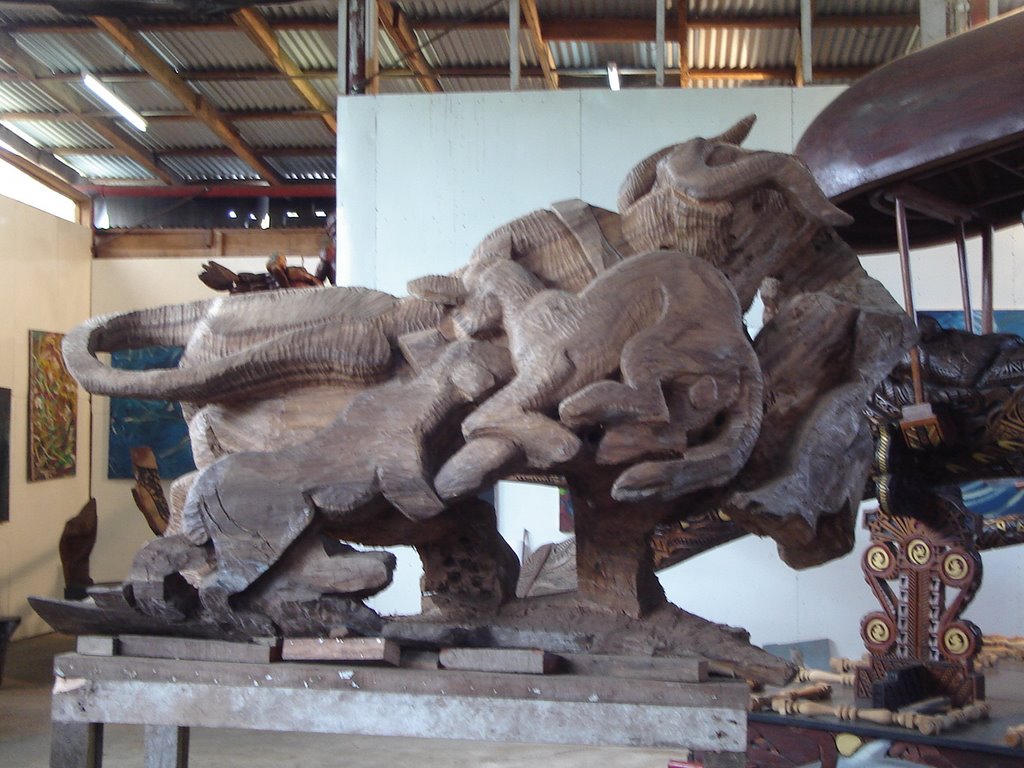
Classes today were pretty short. We finished up our presentations on the village, did a short language activity, and then visited BEN’s School of Art. BEN stands for Beautiful Expressions of Nature and is one of the few art schools in the country. Traditional art forms such as singing and dancing are very much alive; but some of the other forms such as sculpture and painting are almost non-existent. The owner of the school has made it his mission in live to give visual art a more prominent place in Samoan culture. He’s working almost single-handedly which I found incredible. Since the government of Samoa does not really have funds set aside for projects such as his he depends on oversees grants and small projects that he and his students make for churches. One of his carvings was displayed at the Atlanta Olympics and is now in Las Vegas. Another is part of a just completed Chinese sculpture garden. To me the most amazing part was his workshop. His current goal is to turn part of his workshop into a museum with the hopes that it will become the first national museum of Samoa. In the middle of the workshop is a huge hollowed out tree trunk, probably 10x15 feet on which are the beginnings of a new carving. All around are other smaller logs which will soon become sculptures themselves. The completed sculptures which fill up the first half of the room are equally impressive. How do you take a cylinder and turn it into a three-dimensional picture? I think that is something that will always amaze me.

As I was walking around Apia this afternoon in the heat I realized that I’d forgotten another village story and this one I just have to share with you. There are lots of stray dogs or maybe just dogs in general in Apia. It’s one of the few complaints tourists make. One of the first days we were here we were told that they have a tendency to walk along beside you and then all of a sudden they’ll just turn and bite you. One afternoon in the village I was walking with Mirna, RaEsa, and RaEsa’s Samoan mom. We were going down to the little shop to buy something- I don’t remember what exactly. As we were walking along the side of the road we heard a car coming so we moved over into the grass and watched it pass. I turned back around to see this pretty ugly grey dog standing next to me. It looked almost like a greyhound but I knew it wasn’t. The first thing that came to my mind was the warning about dogs that like to sneak up on people. I searched my memory for the correct word to yell at the dog but before I had a chance to open my mouth that “mangy mutt” to steal my grandfather’s term bit me! I was so mad. I couldn’t believe it! That stupid dog actually bit me! On my leg! All I wanted to do was punch him in the nose but I think he knew it was coming and took off running across the yard. I mean serious! What had I ever done to it! Mira and Esa of course were almost crying from laughing so hard. I was so angry. That didn’t help. They thought that seeing me ready to beat that darn dog was the best part. Thinking about it I’m still angry and I can guarantee you that if that dog ever comes near me again he wont be biting any more innocent pass-bys. The End. (Side note- he didn’t draw blood and they don’t have rabies. It was more just a lot of hurt pride and a small bruise…but still! The nerve!)

Monday, October 02, 2006

Samoan humor


In Samoa you laugh at everything; even things that aren’t funny like a little kid getting beaten. However you are also allowed to laugh at things that would be considered funny in American/Western humor. Last night before dinner we all had to share one funny moment and one moment that really stood out from our trip. Going around the table I realized that I had neglected to mention some of the funny stories from the village so I’ll try to share a couple of those now.

Tuesday, after we made the umu, we went back to Jackie’s house to play a language game. Let me first describe the layout of the “compound” for lack of a better word. The school building/Jackie’s house is in a circle with four other houses and a store. A little further back is a fifth house, the Samoan kitchen where the umu was made, the chicken coop, and several other storage type buildings. This little area is where most of Jackie’s family lives. But back to the game. The game that day was a scavenger hunt with the clues given in Samoan. We were told that it was a race and that there was a nice prize to be given to the winning team. My team was composed of three people: Mira, Rachel, and myself. We were given the first clue which said something about the “falemoa” or chicken house. We looked at each other and ran out the door not stopping to put on our shoes. This turned out to be somewhat of a mistake since the muddy ground was strewn with rocks and coral. We quickly picked our way across the courtyard until we came to the house that was removed from the rest and called out to the group sitting inside “falemoa?” They looked at us and pointed to the right. Off we went. We must have made a funny site holding our language books and lifting our knees high in reaction to the sharp path. I reached the coop first and grabbed the pink paper which said something about the book “Mary Mary.” “That’s on the bookshelf,” Rasela called so we turned to go back. As we quickly started picking our way back across the yard I realized that something didn’t feel right. I looked down to see my lavalava undone in front and threatening to fall off completely. All I could think of at this critical moment was Jackie telling us to “Pick it up and twirl it around” if it were ever to fall off in public. Trust me if it had I very well might have.

Another funny story that wasn’t quite so funny at the time happened one evening after dinner. Although the family I stayed with had electricity the bathroom (which as I mentioned earlier was slightly removed from the house) did not have a light in it. Not really that big of a deal right? Usually the light from the room from the upstairs room filtering in through the slot above the door was enough to allow you to see all that was necessary. Since dinner was normally eaten around 7pm the sun had already gone down and darkness was only broken by a few street lights and the lights from the few nearby houses. We were sitting in the Samoan fale when suddenly there came a screaming from somewhere across the yard. I knew at once that it was the four-year old but I had no idea where she could possible be. Had she fallen down and gotten stuck somewhere? Vaiula and I ran across the yard to try to locate her. It was then that we realized that she was in the bathroom- stuck. Let me say another word about the bathroom. It was build out of wood with a metal roof and concrete floor, and was just big enough to hold a toilet and a person. It could be closed from the inside by a sliding latch and the outside by a wooden bar that slid across to hold the door closed when it was not in use. One of the first things I’d noticed about the sliding latch (similar to the ones in bathroom stalls across America) was that the metal part which stuck out a bit had a tendency to fall out and get lost on the floor. This meant that if you wanted to leave the bathroom you had to search on the ground for it. Easy enough during the day but at night? You’d better hope that you could find it by the light reflecting off of it. Once we knew where the source of the sound was we knew what had happened. She’d lost the pull and couldn’t get out. Her grandfather came running across the yard and proceeded to try to yank the door from its hinges. No luck. Whoever had attached it had done a great job. At this point I was torn between feeling bad for the poor little girl and laughing hysterically like the rest of the family. I mean- she was stuck in the bathroom! But then again- she was stuck in the bathroom because the latch didn’t work but why replace something when it can still do the job? Finally, the grandfather picked up the ten year old and stuck him through the twelve inch gap next to the ceiling. For a ten year old boy it was fairly simple to find the missing piece, insert it in the correct place (also rather tricky even in the daytime), and open the door to free the still terrified little girl.

That’s all for now folks! Today was rather uneventful. After starting class at 10am (yay for the free morning) we had to give presentations on some aspect of the village that we’d been assigned before we left. After lunch we divvied up the gifts from the village. Some people went into Apia while I set up a few research meetings for later in the week and then headed back for a pretty fantastic two hour nap.

Sunday, October 01, 2006

Ten days in Lotofaga


I’m BACCKKKKKK!!!!!!!!!!!!!!!!!! Ten days in the village and I’m still alive and kicking. Maybe it wasn’t that bad after all. There were some times when it was a little hairy, but overall I must say it was a very good experience and I’m glad that I did it.

I stayed with a family of six. My host mother, Sipili, is a Grade 1 teacher and the assistant principle of the local primary school. Her husband Tuaitau is a planter. They have five children- four boys and one girl. The oldest boy, P.S.A, lives at home with his wife Conzuela and their two children Laisene (who is almost 4) and Edweena (who is three months.) Sipili’s two youngest children, a fifteen year old girl named Talia and her ten year old brother Viula also live at home. The other two boys work and live in Apia and I never met them.

They live in a rather nice palagi house. It’s two stories with a connected bathroom and shower. I was one of the lucky ones who had an actual bathroom to shower so I didn’t have to use the bucket by the road. They also had a fale Samoa which is where the parents slept and spent most of their time during the day since it’s cool and gets a nice breeze. The other two buildings on their piece of land were the kitchen and the Samoan kitchen which is where the umu is built.

About half of my time was spent in class at Jackie’s house, which was nice because I think I might have gone crazy otherwise. Don’t get me wrong. Some of the members of my family were very nice. I loved my sister-in-law and her two kids. Without Zuela I probably would have gone crazy. She’s twenty-six, very pretty, and also I think a bit lonely. She comes from another village and moved here to live with her husband’s family. Her own village is a fifteen minute drive or so, and her family owns some beach fales which are popular with the tourists. I could be wrong in this, but it seems like most of the work around a house is done by the in-laws. Zuela did all of the cooking and most of the housework in my family. At one point I asked Talia if she liked her sister-in-law and her response was “oh yes, because she does all my chores for me. I just go to school and play volleyball. Zuela does all the rest.” The same was true for the family across the street where Mira stayed. Most of the plantation work was done by the son-in-law, not the sons who still lived at home and spent most of their time laying around and playing volleyball.

In general life is very relaxed. Unless a person has a paying job they don’t really do a whole of anything during the day other than getting and preparing food, and relaxing. Don’t get me wrong- it’s not that easy when it means picking or fishing or killing every meal you eat, but there is still an awful lot of sleep and down-time. It was quite strange, especially for us girls who then had very little to do since most of the work, including the cooking, is done by the men. It was a little different in my family since Zuela cooked most of the meals, but even then it was nothing like what we were expecting.

Going to the beach isn’t that popular either. It’s a ten minute walk to a beautiful sandy beach on a reef, but most adults never go unless they are fishing. I took my snorkeling set out several times. It’s so easy to get lost in the underwater world. The little boys also loved my set so it was hard to go for very long. They monitored my time usage pretty closely and made sure to tell me when my time was up.

It would be hard for me to go through a day-by-day play of what I did so I’m going to copy and paste bits and pieces from my own personal journal, and use that to build on for the rest.

9/21/06
“I find that part of me begins to agree with Kalia. I’m only five years older than Talia. She does not have to be my slave.” One of the hardest things for most of us to get used to was the almost stifling service. The first thing my host mom did when we got back to the house after the welcome ava ceremony was sit down and tell me that I was her daughter and that we were family. She then proceeded to not allow me to do anything on my own. We all wanted to fit in and be part of the family but it was not something we were really allowed to do. Or at least some of us weren’t. I ate with the parents, was served by my supposed sister, got food no one else got to eat, and was not allowed to really help with anything when Sipili was around. One of the nice things about Zuela is that she would let me cook and eat in the kitchen with her and help her with her chores. I was able to experience some of the actual work that went on. I also just really wanted to eat what everyone else was eating. It’s hard to eat much when you know the little kids are eyeing your food and just wishing that they could have a bite. Looking back the first couple days were very much days of hostility. We went in being told to try as much as possible to become part of the family but looking back that is a rather unrealistic expectation. Once I gave up trying to do that fell into a more comfortable “long-term guest” role I was able to enjoy myself much more. Some people were going to treat me a certain way and I left it at that. Sipili was going to insist on cutting my taro every evening at dinner. There was nothing I could do about that and so getting frustrated was pointless. On the other hand, since they insisted on treating me as a guest I had more freedom to wander around with some of the other students.

9/23/06
“Riding to the plantation today was pretty sweet, but I wish they’d let me ride the horse by myself. It would have been so much more fun! I know- I’m complaining.” As I mentioned earlier my host dad was a planter and they had two plantations. One was right next to the house and the other was a fifteen minute walk. The plantations mainly hold coconut trees and taro, and someone from the family goes almost every day to collect the food for the evening meal. That would be one of the hard parts of life. Many of the families who worked the plantations also had horses to haul back the food. Horses also served as lawn mowers I was told. Families who don’t have horses still cut the grass the old fashioned way- with a machete. Sounds like fun right? Since I’d expressed a desire to ride the horse when I arrived on Thursday they told me that they would let me ride it on Saturday. I felt like such an Indian. We used a rope for a bridle and leaves for a saddle. It was pretty amazing.

9/24/06
“Thoughts on the day- they just drag by so slowly. We don’t do much besides eat and sleep. The heat kills all desire to move around and be active. Wow ok and the wind just changed directions- not the best smell. The pace is so different from the States. I haven’t really figured out what people do here. But more on that later- I’m going to go help my ‘sister’ with an assignment.” The assignment was an English assignment. I helped her with several during the week and they were pretty tough. I don’t know where they get them from but I’m not really sure how they expect them to come up with the answers.

9/25/06
“Last night I had so much hostility. Waking up to find gum all over my clothes- I waws so angry with Talia.” I shared a queen size bed with my Samoan sister and she went to bed with gum in her mouth. I woke up to find my arm in the gum and it all over the back of my shirt. Needless to say I was not so happy, especially since I’m not sure how accidental it was. The evening before she’d wanted to go get pancakes = doughnut holes. We spent two hours waiting for them. Or rather, I spent two hours sitting around and she spent the time flirting with her boyfriend. When she was finally ready to leave it was time for our evening check-in so we went straight to Jackies. Neither of us had eaten dinner and since I hadn’t eaten she couldn’t go home because she would have gotten in trouble. So, while we were in class she sat outside with her boyfriend. We ended up having snacks and stuff so I was fine, but she ended up not eating and I think she was a little upset at me. It was definitely not my fault. I was almost in tears by the time we’d gotten to Jackie’s house. I was hungry, tired, frustrated, and feeling very used by this fifteen year old. Oh that and she didn’t want to give me back my change after I’d paid for the doughnut holes. Jackie assured me that she’d done it before and had probably stolen $100 American from the last SIT girl. I’m glad she told me that because it helped me realize that I didn’t have to be quite so nice. Sunday evening was probably the low point of our trip. Talking to Jackie that night the light bulb went off in my head and things got much better. “I think things will be ok. It was rough for a little while, but I think they might be changing for the better.”

9/26/06
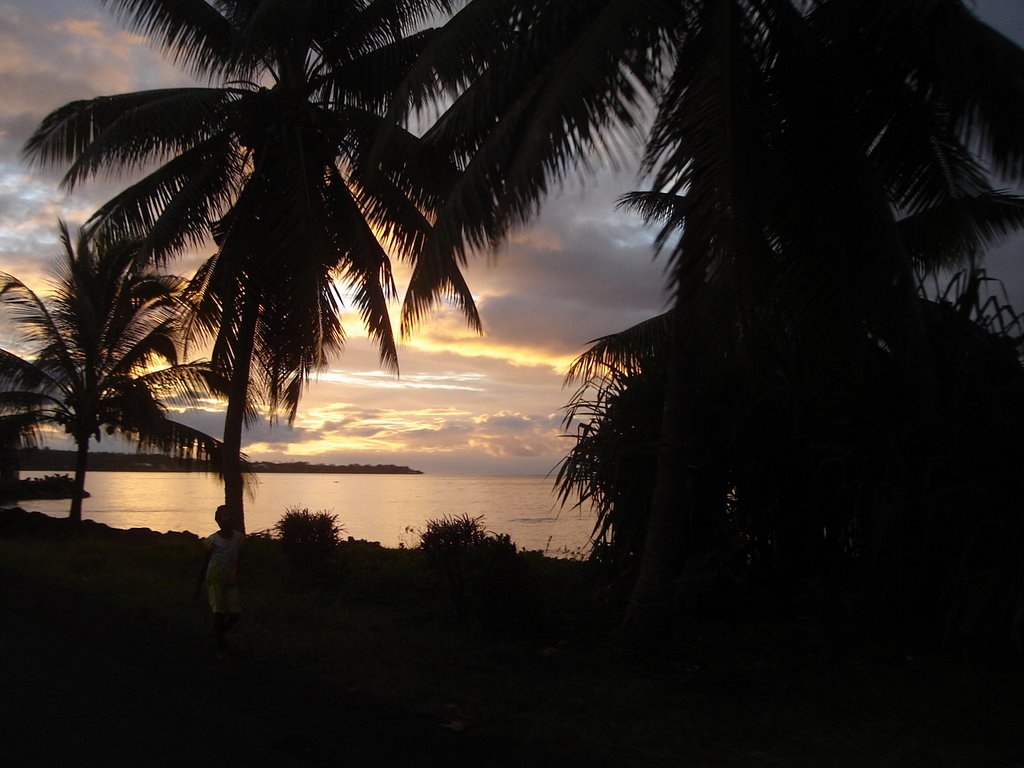
“Watching the sun rise from my bed this morning was so beautiful and so random because it only lasted for a minute or so. Looking past the mosquito net and glass and screen it was the first thing I saw when I opened my eyes. The green and yellow foliage of the tree tops and the dark green of the coconut trees met the pale blue sky, and in that space the white clouds became a swirling mystery of colors. Was it purple? Or a darker blue? Now it was golden. Nor was it the entire sky- just the little piece framed by two tall coconuts and partially hidden by ever-green trees. This was the beauty that has captured the hearts and souls of so many sailors and poets. A breathtaking moment and a glimpse of paradise.”

“Things I learned today/did today:
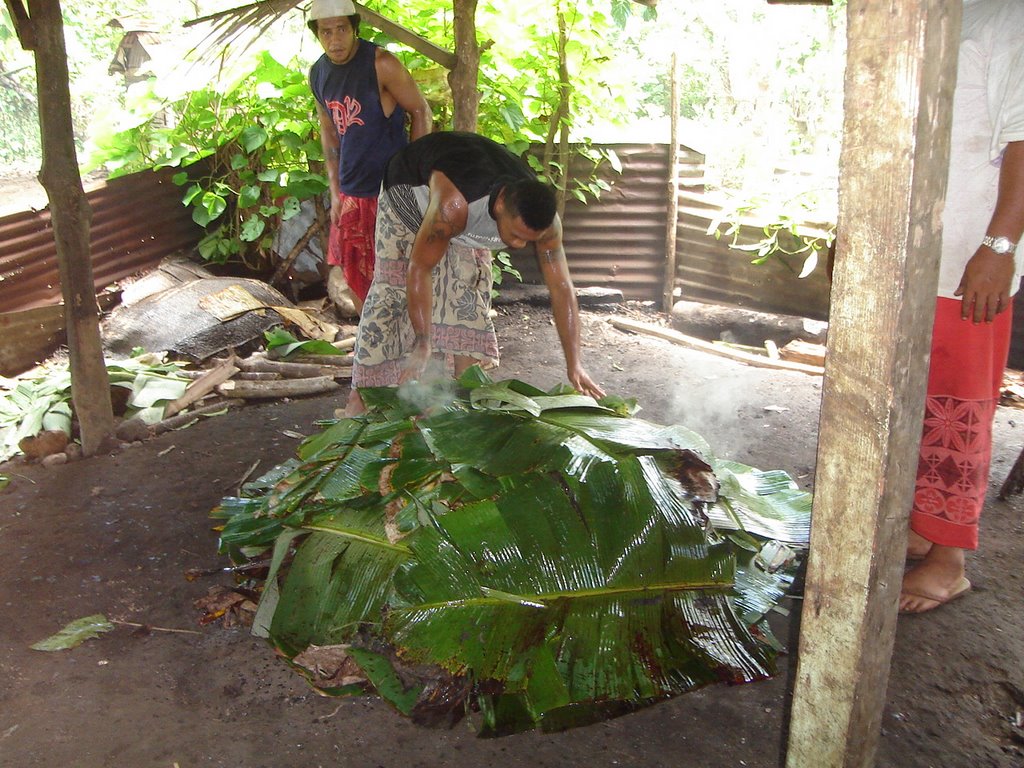
- learned how to build an umu ( a Samoan oven), from lighting the fire and heating the stones to covering the food with leaves
- scraped taro with part of a tin can to remove the dirt and purplish inner skin
- peeled green bananas with a sharpened sick and got sticky goo all over my hands
- scraped the inside of a coconut. As with everything else it was much harder than it looked
- wrapped the palusami in its many layers of leaves; yes there is a trick to it
- husked a coconut despite the fact that the husk really liked being where it was
- made an eating plate/bowl out of the leaves of a coconut tree
- saw a pig killed and gutted
- realized that big lung is quite delicious when cooked well
- ate some delicious octopus
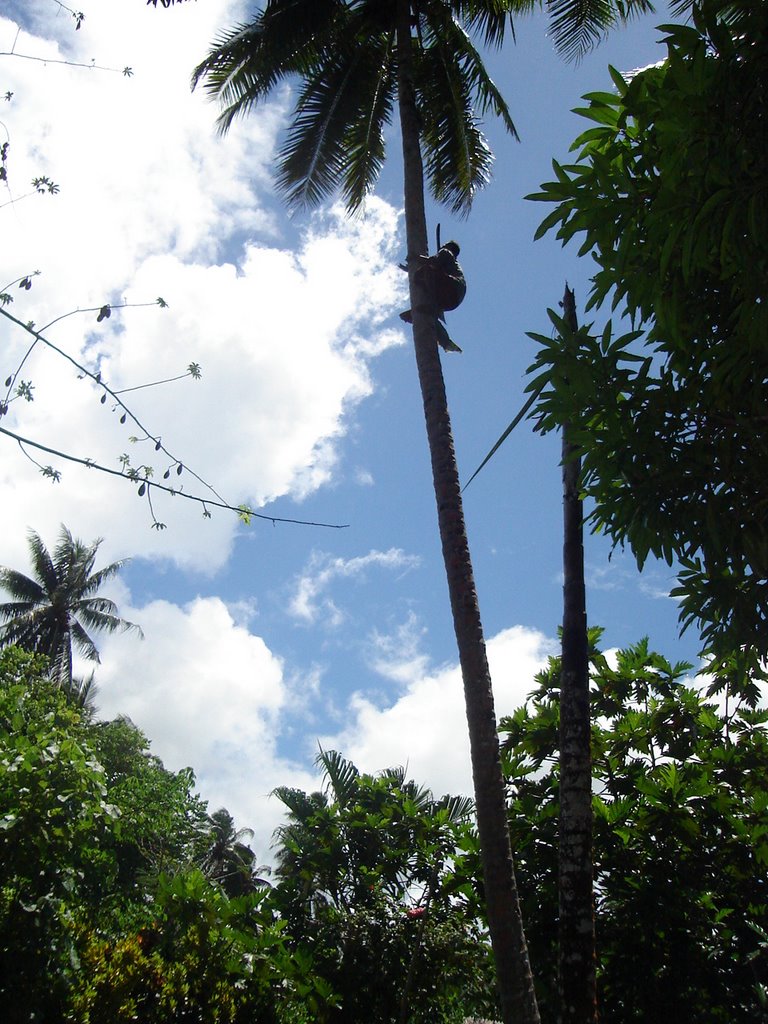
- watched a deaf man climb a coconut tree with a knife between his teeth
- watched cocoa being made
- learned how to sasa, a dance done sitting. It mainly involves a lot of clapping and knee slapping
- blew the conch for sa. This was one of the highlights for two reasons: it took me about ten minutes to figure out how to place my lips; and because my Samoan mother told me at dinner that Mira and I were the first girls to blow the conch in Lotofaga because it was a boy’s job
Oh and I saw an awesome shooting star last night. I think it might have been my first one ever.”
Tuesday was one of the coolest days because spent it in hands on learning.

9/27/06
“When I woke up this morning I helped Zuela make cocoa rice. Tuaitau had already done the cocoa but we still had to husk the coconuts, scrape them, and squeeze the milk from the shavings. It was delicious, but it made me appreciate how hard they have to work for food. When they are happy living at a basically subsistence level there is no need to do much more. You spent the time you need preparing food but after its all over you are free to rest. Tuaitau didn’t leave the Samoan fale for hours. Several of the girls were complaining about not having anything to do- but that’s exactly what they do everyday- nothing. We are just so used to the rat race of everyday life and the mentality that being busy makes you important that we cannot accept that ‘doing nothing’ or ‘malolo’ is a perfectly acceptable way to spend the day.” Wednesday we had no classes so that we could spend another day with our families observing life. It was nice to have another break in the middle of the week when we’d gotten a little more accepted into our families and were actually allowed to help with some things and not relegated completely to the “guest on the side-line” role.

9/28/06
“Today was a very long day in terms of hours and things done. We spent the morning observing and teaching in the Primary School of Lotofaga. Niko, Cheryl, and I had Level 7. We went over food groups with them and then played hangman. Question: what kind of food is a breadfruit? How about taro?
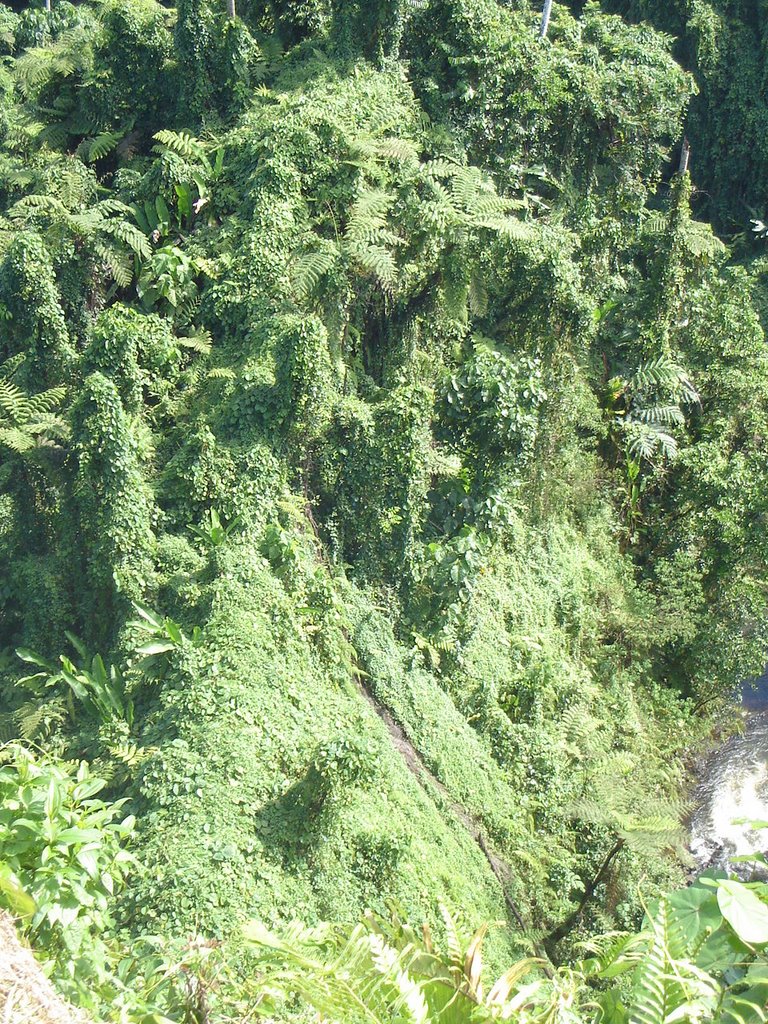
In the afternoon we all went to a beautiful and quite stunning water fall. With all of the rain we’ve had lately it was roaring. The power was quite impressive. The roar, the white mist, the dense green all around. It must have been 70 feet tall. What would it be like to be the first explorer to see that? To hear it and know it was out there somewhere? What would it be like to be hiking through the rainforest? It makes me really want to go to South America.
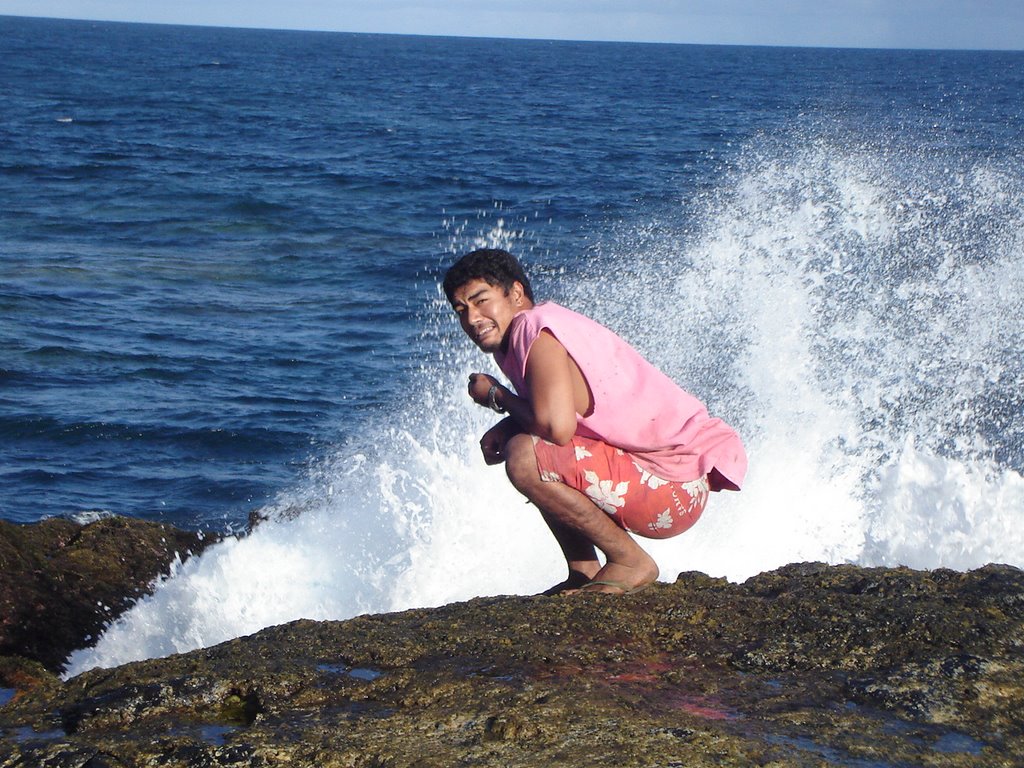
Later in the afternoon I went to the blowholes with Zuela and PSA. It was somewhat of an ordeal because my mom wasn’t sure if she wanted to let me go. The mothers are convinced part or maybe all of Kati’s sickness is caused by the spirits and they are afraid it is because of her visit yesterday to the blowholes. Since she got hurt on Tuesday though that’s not possible. The whole spirit thing is interesting however. Even Jackie believes it. How do you reconcile that with Catholicism? I don’t think I know enough about their beliefs. Poor Kati though. She seems pretty sick and last night with the healing/Samoan medicine must have been pretty painful. But back to the blowholes- the tide wasn’t right so there was nothing but air. However the lava formation itself was worth the 10 minute walk and 2 tala. I would have regretted it if I hadn’t gone- esp since I was so close. I’m glad I went with PSA because he knew it well and I felt safe following him out. It was also nice because Zuela has never been to that side of it. We even saw a small shark in one of the little coves. The coral was also pretty intense in one part. Other highlights: waiting 10 minutes to get a picture of the wave action behind PSA; going down to check out the underneath water flow; the huge cave; getting a fish and shellfish from the fishermen in the sandy beach on the opposite side.”
I don’t know what else to say about this day. We were going all day, but I was able to see some of the natural beauties of the area.

9/29/06
“The fiafia was tonight and despite my fears that it was just another annoyance it was a lot of fun. Time to just relax and let it all hang loose. Some of the mothers were absolutely hilarious and almost dirty dancing if such a thing is possible in Samoa. Others, like my mom were more formal and serious in their dances. Both groups did several numbers. I feel like our dances went very smoothly if I may say so myself. The boys totally stole their show though with their play. The audience went wild with laughter the first time one of the boys said he “wanted some milk.” When it came to the free-style dancing Niko really stole the show.
The bad part about the fiafia was the pulitasi I got as a figt. I didn’t know whether to laugh or cry when I saw it. It was absolutely hideous. Black background with bright big flowers all over it. I don’t know where they got the fabric but I doubt they could have picked an uglier one. Kalia says I’ll laugh about it later and I’m sure I will.”
Memo: I’m laughing now. I’m sure you will too when you see the pictures. :-P

“Poor Katie is still pretty bad. Jackie missed the fiafia because she took her to Apia. This morning when we got to school the healer was there working on her. You could tell that Kati was in so much pain from her crying. It did not help however. Jackie seems convinced that it’s the spirits and that she’s not getting better because she doesn’t believe in them or the healer. I’m not so sure about that. I think the problem is more that Kati was not doing anything to help herself. Not only was she not eating, but more seriously she was not drinking much at all. She was getting very dehydrated and that I feel is the main reason that Jackie decided she needed to go to the hospital- to get an IV.” Kati is doing so much better now. It was probably a combination of several things- a sprained ankle, an infected coral cut, and dehydration. She’s going to with us to get pizza tonight so that’s a very good sign. Except for her taped ankle she looks almost as good as new.
Tuesday, September 19, 2006

An ice cream cone

After classes today I went to town to run a few errands with several of the girls. When we were finished we decided to get some ice cream. Anyone who knows me knows that ice cream and chocolate are two of my biggest weak spots. If I’m having a bad day and you want to cheer me up- that’s the way to go. And of course, on a hot day, nothing beats cold, creamy deliciousness. We bought our cones for $1.80 which translates to roughly $0.60 in American dollars. Not much right? But when you think about it, that’s almost the amount the average Samoan makes in an hour. Two tala per hour is the average wage. At that rate a McDonald’s worker would have to work for four hours just to be able to buy a BigMac here. Crazy eh? It makes you really appreciate what you have.

I know I’ve talked a lot about going into town, but I don’t think I’ve really described it. I still couldn’t draw you an accurate map, but maybe I can at least give you an idea of what it is like. First of all, I’m not really sure how many people live in town as I am very bad with numbers. What I can tell you however is that it is not very big at all. The center of town, where most of the shops and buildings are located, can’t be much bigger than a square mile. I can walk from almost any two points in under twenty minutes. There are two many markets in town- one that is mainly food and the other that has lots of handy crafts and lavalava’s etc. There are several big buildings with the two most prominent ones being the national bank and the government building. The tallest building is six stories tall. (I think) Think small town America but without any big town around. This is the biggest town in the island. It is the center of commerce. The movie theater is here. All busses go through Apia. There is a fish market here. Some of the big hotels are here. (Apparently the others are on the other side of the island near the good surfing spots.) The first time I walked into Apia I thought of downtown Nederland times two.

Also just as a warning…Thursday morning we are leaving for the village of Lotofaga for ten days. I can tell you positively for a fact right now that there will not be internet access there so I will not be able to update until I get back. Don’t give up on me though! I will be back and I’m sure I will have many things to share.

Monday, September 18, 2006

A word about transportation

I am now going to say a word about transportation in Samoa. In the US there are many ways to get places. Of course most importantly is the fact that almost everyone has their own car. Not so here. While I am by no means an expert on transportation in Samoa I feel as though I can at least provide some insight.

I’ll start with the bus. The bus is the basic means of transportation on the island. They are cheap and run everywhere. They have no schedules and there are no bus stops. If you want to ride one you either go to the market or you wave one down. When you are ready to disembark you pull the cord attached to the little horn by the driver’s ear and he will stop the bus. It’s a very informal system. The older busses, which comprise the majority of the busses here are old Chevy frames that have been built up and have seats on the inside. They are very colorfully painted on the outside, and all of them have their own unique name. Unfortunately Chevy has stopped making the frames so they are now switching to more conventional looking busses. Busses also have no passenger limit. And by that I mean if all the seats are taken find a lap. Any lap will do, but preferably one at the back so that its easier for people to get on and off of the bus. I rode in at least two busses this weekend that easily had fifty people crammed on them. I’ve been on crowded busses before but normally I’m on board before they get full and towards the front so I just sit and laugh inside as more people climb aboard. Saturday morning however we were two of the last people on board the full bus headed to town. I knew it was coming the moment I got on the bus. And of course it had to be 99% male. I walk towards the back. I knew theoretically how the “sit on someone’s lap” worked but had never had to actually do it. Of course by this point all the guys are laughing at me. There are probably two women on the entire bus and they’re at the front. Whose lap was I going to choose?

Next in popularity is probably the taxi. Most people do not own cars so it’s cheap and convenient to take a taxi. Also, busses don’t run after 6pm so if you need to get anywhere your best bet is to call for a taxi. As far as taxis go they are relatively uninteresting. They aren’t much different from the ones in the states except for there are no fares posted so you’d better know how much you should be paying because many of them will try to rip off palagis.

Finally, there is always private transportation. Not many families own cars as they are very expensive. Most of the cars were sent from oversees which adds another interesting dimension. Due to American influence during WWII- we built the roads still used today- people drive on the right side of the road. However, many of the cars come from Australia or New Zealand so the steering wheel is on the right side of the car. Or the wrong side of the car depending on how you look at it. They tried to pass a law forbidding the importation of right-sided steering wheeled cars but I don’t think its going to work. Also, as far as I can tell the theory that applies to busses also applied to car- pack in as many people as possible. Driving home on Friday we had ten people plus luggage in a little jeep. With no AC. Quite a common occurrence I was assured.

My weekend

I had a very interesting weekend. Some of the Samoan students here at USP had volunteered to host us for a couple days to let us experience life with a Samoan family before our ten-day long village stay which begins later this week. I went home with a girl named Luki who lived in Vaitele. She is one of thirteen children, most of whom are already married and living elsewhere. Two are actually married to American’s. As far as I could tell there were about twenty people living in her house. Or maybe it was eighteen plus her eldest brother and his wife who lived in the shack ten feet away. Her parents are separated so her dad lives in Savaii. Her mom is the village doctor.

How was the weekend? Overall it was very good. Before I left this morning they told me that I was to consider them my Samoan family and the mother started crying. It is absolutely incredible how welcoming the people are here. They may not have had much, but everything they had was mine the moment that I arrived. They lived in Vaitele, which is free-hold land so they actually owned their property unlike the majority of Samoans who still live on community land. The village was also interesting in that most people lived in palagi houses with fences. Luki’s family did not because her mother preferred the open fale, which I think I’ve described earlier. A fale is open on all four sides with a roof. They were also unique in that their shower was enclosed in metal as opposed to being completely open like many of the other students. Still not much however when you realize that its just a pipe hanging out of the wall about six feet off the ground. You also change completely in the open so I was very glad our teacher had given us a brief lesson on how to change and shower modestly in the open. By the end of the second day they’d gotten used to me so it wasn’t a big deal but when I first got their the little kids watched every movement I made. You try getting dressed under that kind of scrutiny!

Friday afternoon I went to my first rugby game. It was between USP and the NUS- National University of Samoa. We got our butts kicked royally. After the game we went to the Institute to pick up Luki’s sister Kanesa who leads one of the Bible studies there. Kanesa spent four years studying at Brigham Young University in Hawaii and I really enjoyed spending time with her. We went to Apia and were going to see a movie but there was only one left and they’d already seen that so we ended up just walking around, getting some BBQ and sitting under a tree in “downtown Apia” and chatting for a while. They seemed to know everyone! I guess it really is an island eh? We knew that most of the bars had been closed down for a couple months so I didn’t really know what to expect as far as a night-life, but apparently it consists in cruising around or walking around downtown, eating BBQ and perhaps having a couple Vailima (Samoan brewed beers) and just relaxing.

Saturday was how-to-put this…fun looking back but a little rough at the time. I didn’t sleep very well Friday night because it was my first time to be in that environment. I slept on the “bed” which was basically a mat raised up so that there was storage underneath. There is only one room in a fale so everyone sleeps together. I grew up sleeping in the same room as little kids but its been a while since I’ve heard crying babies in the middle of the night so I woke up several times. I also woke up at 4am when the roosters began crowing, and then again at 6am since Luki had a volleyball tournament in the morning. Two of the boys were staying with some of her friends from the same town and we planned to meet them at one of the beaches later that day. At around 10am they showed up at the tournament and picked me up since we were still waiting for the rest of her team to show up so that they could play. I haven’t figured out if there is such a thing as a forfeit there. The boys picked me up with beers in their hand so I figured that they relaxing day was going to include a little bit of alcohol. Yeah it was a little early, but I figured ehh…it’s Saturday. If I’d only known I would have run the other way. Also, before I go any further let me just state for the record that I am not a big fan of beer and that over the course of the day I had probably a grand total of one beer. And just how long was the day? They started drinking at 10am. They were drinking until midnight when they finally ran out of case number 6? There were about ten guys and four girls because one of the other SIT girls showed up with her host. None of the girls drank so that beer was divided up among the boys. It was basically an excuse for them to be drunk the whole day. I’m sorry if I’m offending some of the people reading this, but it is the dark truth about drinking here. They drink to get drunk and they drink an obscene amount of it. Although before you get the wrong idea I should probably add its more like a heavy buzz and not the drunkenness of American’s because they really do want to prolong the “happy state” or whatever. I dunno. I think it’s stupid. I am a firm believer that moderation in all things is good. Oh, and they don’t eat while they are drinking so even though we begged numerous times for food they never brought back anything besides a few cokes and some chips. I probably had 4 liters of coke that day. It was one of those nightmarish situations when you just wonder when and how is this going to end? I didn’t realize this at the time but one of the reasons we were stuck in the situation for so long was that both the girls who were hosting had given them all the money they had even though none of us were drinking. I’m still trying to figure out why she did that and my only guess is that they were trying to make everyone happy and that they’d never been in a situation like that. To me it’s just common sense- if you aren’t drinking why contribute to the pot? Anyways, that was the annoying part of the day and the part that seemingly would never end. It wasn’t all bad however. The beach was beautiful and it was for the most part a very relaxing day. I didn’t start getting frustrated until around 6pm when I hadn’t eaten all day. We swam about ¼ mile to and from this other side of the reef. I joined in with one of the Samoan teams racing practices. They are apparently practicing for the South Pacific Games so it was a lot of fun. Not as easy as it looked either to be completely in sync with five other people. I also had a great time hanging out with everyone. It was fun. Very chill. We sat around and talked. People have such different experiences here. It’s a very laid back life.

Sunday was also just a great day. After church they we had to’ona’i and then slept all afternoon. In the evening some more of their cousins came over and we went for a walk and laughed and talked and had a great time. I’d been very tempted to go back to school at 6pm with the boys, but I’m glad I stuck it out because otherwise I would have missed out on the evening. After getting home at midnight the day before and knowing that everyone in the family was worried I was feeling a bit like I was imposing and wanted to completely remove myself from the situation, but staying was very much the right thing to do. Those extra couple of hours turned the whole weekend on its head.

Thursday, September 14, 2006

Thursday ramblings

Last night I ate with my Fijian roommates. Normally the SIT students eat with whoever else is eating in the dining hall, but yesterday I decided to try something new and “packed” my dinner to bring back to the room. Most of them bring plastic containers and carry their food back to the room to eat together. They also bring food for those who are busy but who want to eat later. Let me just say a word about the food system here on campus. Breakfast consists of either tea or Milo, four pieces of toast, two pieces of butter, a piece of fruit, and an item that changes daily. It might be eggs, tuna sandwiches, baked beans, or cereal. Everyone gets the same thing. For lunch we are on our own and can pay for each individual item. Dinner consists of tea or mile, either cooked bananas, taro, or rice along with another hot dish, perhaps a salad of sorts, and dessert of some kind. Everyone gets served the same amount which means that we all get huge portions. I have yet to be able to finish one which means that I always have leftovers that go to waste. Last night I discovered what to do with them. Anything that is not eaten by the girls in the house gets left on the table. Invariably there is someone who missed dinner or who is hungry at 1am and they wander from house to house looking for leftover food. It’s such a communal system. Nothing goes to waste. I have discovered the solution to my problem.

In my blog last night I omitted to mention the lecture we’d had that day on agriculture economics. Being the economics nerd that I am I found it very interesting because we talked about the problems facing developing island nations whose main asset is agriculture. Coming from a capitalistic background where markets are driven by supply and demand I found it very interesting. It tied in very well with what I learned later that day visiting the EPC during my drop-off. In general agricultural based economies face different problems from industrialized nations due to things such as the large time lag, greater exposure to natural disasters, etc. Small island nations are even more vulnerable because the limited land that they have and the terrain normally means that they cannot use the equipment used in more developed countries and farming must be done mainly by hand. They also have a harder time setting up factories because of the economies of scale. So what is the solution? Given the problems they face and their inability to replicate Western processes…what do they do? We were offered several possible solutions. Most importantly was that the islands need to work together to be able to have an impact on the world market. They also need to try to find their own solutions and develop their own equipment that is better suited to their terrain. Finally, due to the fact that many farmers here have never even heard of pesticides or fertilizers they hold in their hands the key to the growing demand for completely organic food. There are some obstacles they have to overcome such as developing a grading system and working out transportation issues etc, but I really appreciated being offered at least some sort of solution instead of just being told there are all these problems but no possible solution.

Finally, I have to say that I went to McDonald’s today to get an ice cream cone. It was so hot outside and we’d already agreed to meet there so it was a no brainer. And I can now say I have been to the most popular restaurant in Samoa.

A problem with the water

The one health advisory we were told we should actually heed is the one about drinking the water. Small quantities are ok, but we should avoid drinking it if we can. To that end there was a bubbler in one of the common rooms where we could get fresh cold water. A couple days ago they removed in and installed another sink with a water purifying system of sorts. The problem is that the water coming out of it tastes like PVC glue. We now have the choice of drinking straight tap water or what one of the girls has termed “poison water.” Unfortunately neither of them particularly agrees with me.

Yesterday was our final drop-off in Samoa. We were able to choose a government or NGO office to visit and gather information. The purpose was to discover what government and private agencies there were, the services they provided, and what would happen if you just dropped in on one of them. I chose the NMREM since they were one of the agencies listed in a paper I’d read on alternative energy development- which is the topic of my research. Unfortunately I chose a branch that had several offices. I ended up visiting two since the first one was the wrong one for my purpose. The other one was as well, but at least they were more helpful and friendly. It was really quite amazing. Picture your typical federal government office. Nice building, big desk, at least the appearance of organization. Both NMREM offices that I visited looked like just another house. They was A/C which was very nice considering the heat and humidity outside, but aside from that very little luxury. The woman in the water division with whom I spoke had a very large office on the second floor. That was about the only perk however. There was a desk with a computer and phone, and one small set of shelves. For the most part the room was empty except for stacks of paper on the floor and in binders along one wall. Talk about different.

As I still had some time left after that visit I decided to head over to EPC- Electric Power Corporation- the sole provider of electricity in Samoa. I wound up talking to the head engineer. There are only two in the entire company. He has a Masters in Electrical Engineering from Australia and spoke very good English. Unfortunately he was on his way to Apulima in the afternoon so we didn’t have much time. However, I am planning to go back to visit with him later and he agreed to help me with some of my research. In the short time that I had to talk with him I was able to learn some interesting things. For example: Apulima has ten families living on it right now. Their electric needs are currently being met by a diesel generator. EPC has just finished installing some solar panels on the island and the reason he was flying back out was to ensure they were hooked up correctly before switching over the power. They are making this switch to be able to allow the families to receive power 24/7 even though it is not economical. Currently the diesel generator provides electricity for only 18 hours or so per day. The same goes for the other alternative energy projects currently being researched. The money for feasibility studies comes from the UN and other organizations, but when it comes to implementation the EPC is on its own even in cases where it is not economically sound. I think this project will be an interesting one for me because there is a different mentality in place here when it comes to making decisions. He told me “we do what is best for Samoans.”

After we returned from our drop-offs all of the girls in the group got together for a short dance lesson. We actually have another one this afternoon. Our teacher is our academic director’s daughter, who is a member of a teachers’ association dance group that has performed in China and Taiwan. When we do our long village stay in several weeks we have to perform for the villagers. I think we are also planning to do a line dance to add a little bit of American flavor to it. We shall see. Watching the dancing on TV they make it look so easy. Let me just say that making your feet work that way is much harder than it looks.

This afternoon was another interesting bit of Samoan culture. We had an ava or welcome ceremony with the Samoan students at lunch time. I’m still struggling to describe it since it was part of our experiential learning and we weren’t told much about it before hand. You pretty much sit around cross legged while the talking chiefs give speeches. Of course they did it in Samoan so I have no idea what they were saying. All I know is that girls knees have to be covered while they are sitting and since my lavalava was a little too restrictive for me to sit comfortably cross-legged while they did (I was having issues with it staying on right before the ceremony began) I spent the entire time hoping they would hurry up because my foot had completely fallen asleep. After the speeches are done someone yells something and the brings around the ava cup. How do describe ava? Drinking enough of it will make you drunk, but apparently in a very different sort of way. We’ve been told that it mellows out Pacific Islanders whereas alcohol makes them argumentative. As far as taste and appearance goes it is brown and has a very earthy taste. I think it’s made out of a root. I really should do some more research on it…

Another interesting culture note. Last night I walked into the house and one of my housemates was watching Pirates of the Caribbean on TV. Loving the movie as much as I do I sat down to watch it with her. I asked her if she’d seen the second one and she said “yes but it was very scary to me.” It’s not the first time I’ve heard that comment from students around here. They have TV, they watch movies, they’ve begun to assimilate some of culture but there is still a divide at least in terms of what we consider scary. I think it’s beginning to change but there is still a marked preference for drama over action. It’s also an age thing. We take roller coasters and amusement parks for granted in the United States. Even though they may be quite a few adults who would not under pain of death ride one I don’t think it’s the same fear that even many twenty to thirty year old’s have here. One of the first days that I was here one of the Fijian students in his mid-twenties was commenting about a time when he’d seen a Ferris wheel. It had frightened him and he would not ride it, but he was amazed because there were little kids who really wanted to ride it and who were so excited by it. I guess it’s all a matter of exposure.

Monday, September 11, 2006

Day of remembrance

So I originally wasn’t planning to update because nothing terribly exciting has happened since yesterday but I got an email from my mom and it started me thinking. She’d asked me if I remembered that today was the anniversary of 9/11 and even though I’d written the date several times in class it hadn’t clicked. There are several people here from around New York but none of them had mentioned it either. I think it’s just now hitting me that I am in a very different place right now. Everyone around me speaks English. They watch American movies and TV shows, listen to American music, and even at times dress like Americans. Yes there are many things that are different but there are so many similarities that it was easy to forget some of the cultural differences.

This morning during breakfast the Australian news was playing and the headline was the death of the king of Tonga. There are several students here on campus from Tonga and so that news hit very close to home for them. Given the situation I’m sure that his death also made news around the world including the US but how much so does other news here reach Americans? How much do we really know about what is going on in the rest of the world? How much do we care?

Over lunch I was visiting with one of the Fijian students. I realized that I know absolutely nothing about their history, their culture, the struggles they face. It’s as though we live in our own little bubble. The sad thing is that even though they do learn a lot more about our history and culture than we do of theirs, a lot of it comes from movies and TV. It’s a scary thought.

Another interesting note about culture. People have asked me about the food here. It’s ok. It’s not the most amazing food I’ve eaten in my life but neither is it unbearable. It’s got a pretty good mix in my view. I love the fresh fruit- mangoes, papayas, little bananas, coconuts. To’ona’i was also quite delicious. I’m told that the fish is also very good but I haven’t had much of a chance to try any. Most of the food on campus is Indian to cater to the on campus students who mainly hail from Fiji. People here don’t eat out much since it tends to be expensive so many of the restaurants serve most Western or Asian style foods. There is also a McDonald’s in Apia, the main town in Upolu. We were trying to decide where to go for dinner on the weekend and asked some of the students what their favorite restaurant in town was. The almost universal response? McDonalds! All of us laugh because if given the choice of fast-food restaurants I don’t think McDonald’s is the top on any of our lists. Another interesting tidbit about McDonald’s. I met a girl in the village of Solosolo last week who went to American Samoa for a while for the sole purpose of working in the McDonald’s there. It’s the little things that really force you to think. Is it the food they like or the association?

Sunday, September 10, 2006

To'ona'i


Most Samoan’s attend church on Sunday which is then followed by the Sunday meal called the to’ona’i. Since this is our first Sunday in Samoa Jackie, our academic director picked us up and took us to her church and house. She happens to be Catholic, which was nice for me. Her church also happens to house the only home for the aged in Samoa which is run by an order of nuns by I don’t remember which order at this moment. Interestingly enough they do still wear the habits. When we were in Hawaii someone had told me that they still did services in Latin so I was really excited about that but he was mistaken and they are actually done in Samoan. When I was in France one of the nicest things was that I could go to Mass and it was exactly the same. It was truly universal. Even if I understood nothing else the Mass was the same. Not so when each country prays in their own language. Especially in a day and age were globalization is the theme, how sad is it that the prayers of the Mass are no longer understandable by all travelers. On the other hand however the choir was beautiful. Everyone sings and everyone sings in harmony. No books. People just know their parts. I don’t think churches could have walls because the sound could not have been contained. It was really incredible.

To’ona’i was also an interesting experience. The matai, elderly, and visitors eat first. You eat an open fale, seated cross legged on the floor off of mats with your hands. It is not a culture were leaving food on your plate is seen as food. Anything that guests do not eat is eaten by those who prepared the meal. Oh and get this. The men serve the food. They cook, they serve, they clean. No wonder so many American girls like Samoan men. I mean seriously! I could get used to this. Women traditionally were important because they were the ones who created wealth in the form of fine mats. They were also important because through marriage they would bring more wealth and honor to their family. But back to the meal. Let me just say- there was a lot of food: breadfruit, taro, palusami (which is coconut prepared in some very tasty way and wrapped in taro leaves), squid, tuna, salad, potato salad, squash, some other meat, some kind of noodles, and something else that was soupy and good but I don’t remember what it was. Oh and after that came dessert- pudding cake, ice cream, and cocoa Samoa. It was literally a feast. The men get up at 6am to prepare the umu which is the big oven made of stones where most of the food is cooked. It was an experience. Supposedly we’ll be learning how to prepare an umu when we do our village stays so I’m really looking forward to that.

The definition of beauty


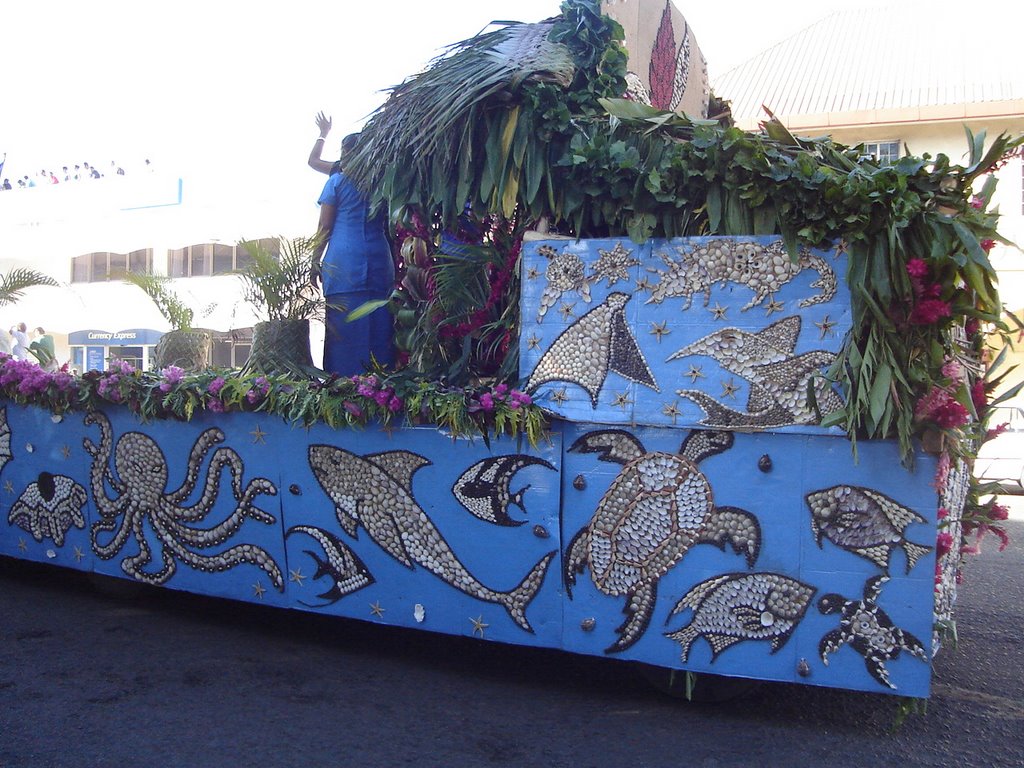
Friday morning we went to the Floral Parade in Apia before classes. As I understand it the culmination of the Teuila Festival is the Miss Samoa pageant on Saturday night and the parade was a chance for the contestants to drive through the town on their floats. The floats were quite interesting. They were sponsored by different villages that were also responsible for decorating them. All of them were very beautiful, and were decorated with greenery and flowers. Most of them also had some aspect of Samoan culture incorporated in them. For example one of them had a hut where a man was actually being tattooed during the parade. Many of the floats were also decorated with turtles since this year is dedicated to the turtles. One of the floats was actually shaped as a turtle. I think the thing that really surprised me the most was that all of the girls were very tall and skinny. We watched some of the pageant on TV last night and they weren’t all models but they definitely seemed to confirm more to the American standard of “beauty.”

Later that afternoon, after our classes were finished we took a driving tour of Apia and stopped by the Bahai Temple. Apparently there are only seven or eight in the entire world so it’s interesting that they have chosen to build one here. The grounds were beautifully kept. Even though people say that this is a very religious place I almost feel like it’s more of a habit than a conviction. Perhaps though I’m over-generalizing or assuming incorrectly based on cultural differences.

Saturday all of us plus a few other students and some friends we’ve made here in the past week went up to Sliding Rocks, which was about a mile away. It’s a series of small waterfalls that double as a natural water park. The smallest one is probably two feet tall and surprisingly enough is the most painful. Another one was about ten feet and had a bump at the end that sent you flying through the air before landing in the water. The tallest one was probably around fifteen to twenty feet high and was much steeper and faster than the others. I was surprised because everyone in the group went off all of them. Honestly I think the hardest part was figuring a way to climb up the slippery rocks to go down again.

Thursday, September 07, 2006

Comments


I just realized that I'd turned off the comment feature but that should be fixed now...I hope.

South of the equator


There comes a moment when you realize that was probably a reason for the way things were done “in the old days.” I mean really- why wear so many clothes? And why sleep in buildings with walls? Clothes and walls are just one more barrier between you and the breeze…just one more thing to trap in the sweat and humidity and heat. In terms of actual temperature Texas might be hotter, but in terms of humidity and lack of A/C Samoa definitely has us beat. The A/C or lack of it is probably one of the biggest things. I wake up every night drenched. And the heat really wears on you too. We had this afternoon completely free so I went to take a nap. I easily slept for a good three hours.

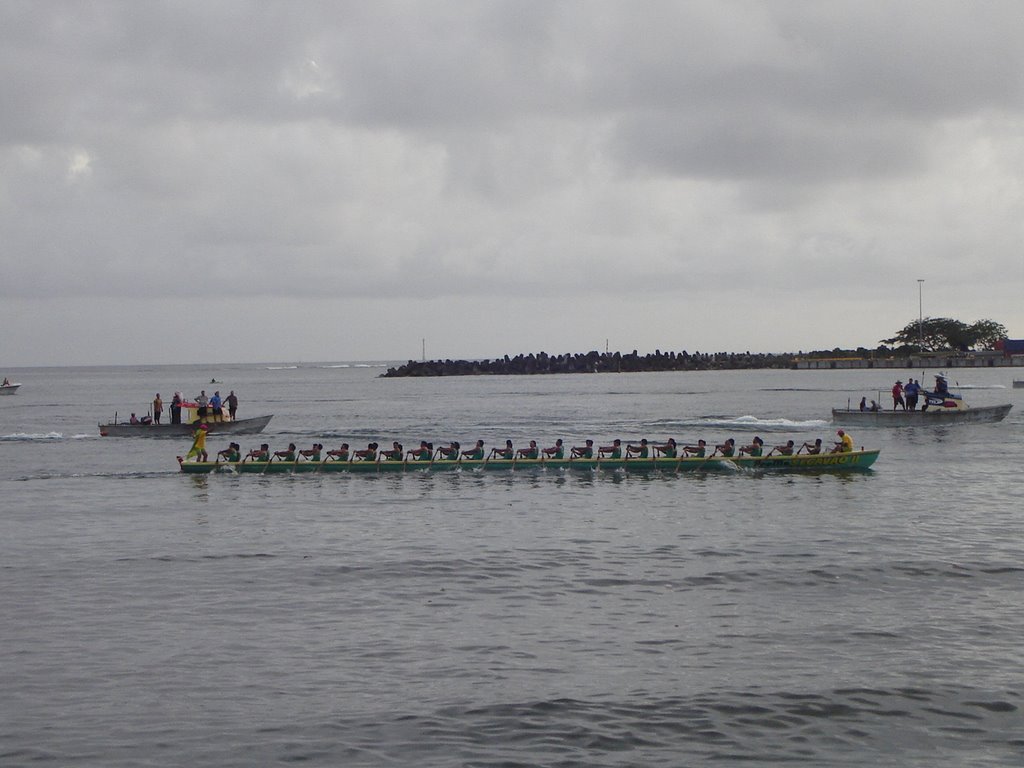
But enough about the heat. This morning most of us woke up at 5am to go to Apia to watch the Fautasi (long boat) races. They happen twice a year so we had to go. I didn’t count exactly how many rowers there are to a boat but my guess would be two rows of twenty-five boys or fifty total. Unfortunately it wasn’t a very close race so it wasn’t that exciting but it was still something to see fifty people working together as a team. If one person is off the whole team suffers. Watching that was pretty cool, as was watching the sun rise over Apia and the water because we were there so early! Although the race started at 6am it was five miles long so watching the end meant they didn’t come around the bend until 6:45. Think of all that extra sleep…

Our lecture today focused on religion and culture. Coming in I’d heard nothing but positive things about Christianity and Samoa, but I’m hearing a must different side of things here. The first missionaries here were from England- the LMS or London Missionary Society. They were soon followed by the EMMS or Evangelical Methodist Missionary Society and the SM or Society of Marists, the Catholics. Apparently one of the big issues for the natives is that they feel like Christianity eliminated some of their cultural heritage without ever becoming something that they felt was their own and no

Wednesday, September 06, 2006

Fa'asamoa


One of the aspects of Samoa that appeals to so many anthropologists is that despite the influence of European cultures Samoans have managed to maintain much of their traditional lifestyle. Now that we are here we are starting to examine what the “fa’asamoa” is and how it has reacted to Western influences.

There are three important things in the lives of most Samoans: family (aiga), village (nu’u), and church (lotu) and in that order. A person’s family can easily include twenty to thirty people when one considers that it includes parents, grandparents, nieces, nephews, etc. The traditional male/female roles that we associate with in America are also different but I’ll get to that in a minute. The next in importance is one’s village. The village council was responsible for the governance of the village as a whole, and decisions made were final. The one aspect that has changed with Westernization is the church. It now also plays a very important role in Samoan life but has been Samoanized in many regards. Until recently villages all adhered to the same sect and even now dissenters can be thrown out of the village. This does cause some conflict with the national government especially as Samoa attempts to become a member of different international organizations. “Human rights” are expected at a national level but are not always easy to enforce at the village level given the traditional Samoan way of dealing with things.

Back to the different roles. The central role in village and family life is that of the matai- or chief. Each family can have several different matai titles to distribute. They can be held by male or female, old or young, those living here or abroad. Their election must be unanimous and because of this can take several years after the death of a former matai. Since Samoa does not have private land ownership the matai is responsible for looking after all other members of the family and for distributing resources. The culture is very much based upon giving which is completely in contradiction with the capitalist way of doing things. Many other Pacific Island nations have similar cultures and this causes conflict when Western ways of doing things are introduced. Traditionally they would prefer to lead a very relaxed life producing only what it is needed. Those who work harder and create a surplus will be besieged by relatives who do not have as much. It’s always been a give and take. You give when you have and you take when you need. How do you reconcile that with the Western notion of working hard, saving for a rainy day, accumulating wealth, etc. They don’t mesh. One of the two must give way. So far the Samoan’s have been able to retain much of their cultural identity in the villages but there are some changes being made. The next group in importance after the matai are the aualuma- or the daughters and sisters of the village. These are the girls born in the village who are not yet married. They are responsible for hospitality. They also are the producers of wealth in the form of fine mats; care for the children; and serve as peacemakers. Unlike many other societies women were actually seen as equals but fulfilling different roles. The untitled men, or aumaga, were the strength of the village. They were the hunters, planters, cookers, and enforces of curfew. Next are the faletua and tausi, or wives of the chiefs. Finally there are the children or tamaiti. Samoan children have much more responsibility, and there is no set age limit or “right of passage” for when they move from one category to another. Instead it is based on education. When they finish school they become either a aualuma or an aumaga. Just thought that was kind of cool.

So, what has happened with the introduction of Western ideals? Closer to towns you find more Western style buildings, but in many places fa’asamoa is still very strong. For example, four of the five bars in Apia closed down for six months because the villagers complained. Where else would that happen? I think things are beginning to change. You can have matai who live in California or New Zealand but they still fill the same roles. So far they have managed to adapt without losing their own unique identity. Perhaps one of the biggest threats to the traditional way of life is the introduction of universal suffrage mere decades ago. No longer are the chiefs and village council responsible for all decisions made- no question. Now there can be disagreement at least at the national level. How conflicts between the village and national governments play out will undoubtedly be one of the forces that shapes Samoa tomorrow.

But enough of me thinking out loud. A lot of this is me trying to learn the material so that I don’t have to spend as much time studying for the tests. :-P

Today was basically a repeat of yesterday. Breakfast, discussion, language, lecture, lunch. After lunch some of us tossed around a Frisbee. I think that’s going to be what I do when I get homesick. I just felt like I was back at Rice. We tried to get some of the Samoan or Fijian students to play with us but were only able to attract one. We’ll have to get a game going at some point to show them what its all about. They’ve only seen Frisbees thrown to dogs. I think it’s time for the next great revolution here- the introduction of the game of Ultimate. The rest of the afternoon was spent in Apia walking around and doing some shopping. I bought another lavalava and some t-shirts at a thrift store. I’ll probably end up doing a lot of my own laundry so it’ll be better to have some shirts and clothes that are easy to wash and I don’t mind losing at the end. :-P

Tuesday, September 05, 2006

Day two in Samoa


Day two in Samoa. Once again I’m typing this up in Word not sure when the internet will work and I’ll be able to upload. I feel like this will be a long semester at least in terms of internet connectivity. I want to be able to check my email but I also know that it’s probably a good thing because if I had a good connection I might be tempted to talk to some people who I really shouldn’t be at this point in time. How I react to that will be interesting. There is such a wide range of emotions there for me. But you probably don’t want to know about that so on to the interesting stuff.

What did I do today? Once again the day began with a brief check-in. We went over what would be required of us this semester in terms of written assignments and oral presentations. It is actually quite a bit. We will be covering a lot of material.

The next two hours were devoted to more language study. I’m going to be honest. After an hour and a half my brain was just not working anymore. I think I’d reached saturation level in terms of classroom instruction. What I need now is to go back to my room and just memorize the vocabulary. It’s hard for me to learn new words under that kind of pressure.

After lunch we went on our second Samoan drop-off. The one was a little different though. We were taken to the market place in Apia and told to take a bus out, ride it for thirty to forty-five minutes, get off and spend an hour in whatever village we happened to be in, and then find our way back to USP. Very broad instructions, and just a little intimidating when you realize that we’ve only been here for a day and a half. Part of our job was to compare and contrast villages further from Apia with those that are closer. I decided before we even got on the bus that I was going to avoid talking to men and just stick with girls. I didn’t want to end up in another awkward situation.

I got on the bus and started talking to a girl named Kareti. She was in her senior year of high school and spoke very good English. I told her that I was here studying and trying to learn Samoan. When we got to her village she got off with me and started taking me around to introduce me to the other families in the village. We ran into one of the other guys on the program (Niko) and he joined us. It was really quite amazing. It’s a little hard to describe what the villages are like but I’ll try. I don’t want to take pictures at this time because I feel like that would make me too much of a tourist and I’m trying to learn about and understand the culture. I will before I leave, but only once I’ve gotten to know some of the people.

Everyone in the village lives in a fale. These are completely open structures built about two feet off the ground. Behind the house is the kitchen and other work structures. Aside from the kitchen most of them are built off the ground as well- probably to get more of a breeze. Since the cooking is done on the ground the kitchen is the one building that is level. Many of the families we visited were resting or relaxing. Walking through the last thing you would expect to find is a TV and stereo system but they’re there. It presents quite a sharp contrast. As one of the other girls said, you walk in and they’re watching music videos. That’s the impression they have of the United States. It’s a little sad. Some of the other families were cooking. In Samoa the women cook the soup and the men cook most of the rest of the meal so we saw boys preparing bananas and coconuts. The one woman we saw cooking was roasting Samoan cocoa.

Kareti was absolutely invaluable. As we went from house to house meeting people she would sit behind me and tell me what to say in Samoan. Sometimes I would say something completely wrong and everyone would start laughing. I have no idea what I was saying at those moments but it made me realize just how little I know of the language and how much further I have to go. It’s very hard to hold a conversation or get to know someone when you only know five phrases. Almost everyone asked when were coming back to the village and invited us back to their houses when we did come back. Kareti will be meeting us on Saturday to hang out with us some more. After a couple hours we caught the bus back to Apia and then finally back to USP.

I guess now just some observations on the day in general. The people are incredibly friendly and welcoming. They live a simple life with no pretense. Clothes and money mean nothing. I would feel so out of place if I were wearing makeup or dressed in designer clothes. In some ways I felt very comfortable because I did not have to worry about what I was wearing or how I looked. The concept of family is also very different. It can include aunts and uncles, nieces and nephews, grandparents. Twenty people can live together in the same household. Kareti is the eighth of eleven. One of her older sisters has died and some of her older brothers are abroad in New Zealand and Australia. Even though she would like to go and have a better future she said that she has to take care of her parents since her dad is sick. The way they deal with death is also very different. Family members are buried in the front yard.

I think this semester will really force me to stop and think about what’s important. I’m not saying that this way of life is perfect, but there is much to be learned from them.

Oh and on another random note- the scenery here is very pretty. Solosolo has a black sand beach. It’s the first one I’ve ever seen. I almost feel like I’m stepping into a storybook. Lush green foliage, deep blue seas. It is a tropical island, but it is also a very poor island and the hardships many Samoans face are just are real as the natural beauty by which they are surrounded.

Welcome to Samoa


I’m typing this up in MS Word but I’m not sure when I’ll actually be able to post it. Internet here is very slow. I’m also trying to post some more pictures, but bear with me because it might be a while.

I talked very briefly about our “Tour of Oahu” with Jack that we did on Saturday. I have some pictures that I’ll post at some point, but I wanted to explain a little bit more about what we did that day.

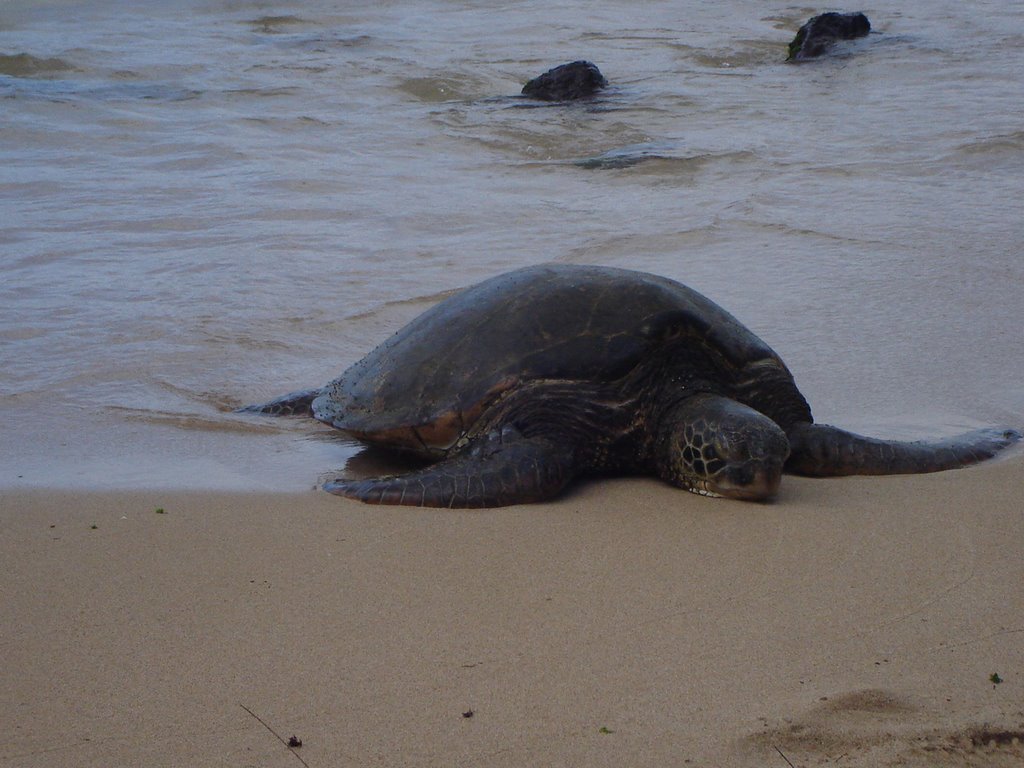
We started out at the Hostel, drove through Waikiki and past Diamond Head. I really want to hike it, but that’s going to have to wait. Maybe in December when I have my twelve hour layover… We continued to follow the coastline. It was such a nice view with the beach on one side and green mountain on the other. For being such a small island there is a remarkable difference in rainfall. At one point you could see a distinct line where the green and brown met due to rainfall in one place but not in the other. After rounding the southern tip of the island we stopped at a blowhole. Unfortunately there were not enough waves to be able to see the effect, but we should be able to see one in Samoa. All along the coast are fortifications built during WWII by the US military in case of a land attack. I don’t think I would have noticed some of them if our guide had not been pointing them out to us. We saw one of them at Manana Island- our next stop. We also saw some paragliders. Apparently it’s a very good place to catch some wind. Our next stop was Waimanalo Beach where we saw a sea turtle in the water. It’s also the scene of a very famous kissing scene but I don’t remember which movie. After the beach we turned inland and visited a Hawaiian Heiau. Basically it’s a pagan temple where they might have had human sacrifices to the god of war. We also got a little botany lesson here. I wish I could remember more of what we were told. There was this nut that had all sorts of uses but I don’t remember the name. It did give me a lot of respect for people who used to do things without all of our modern technology. Think of how long it must have taken to discover and perfect some of their techniques! Further inland we came to Pali Lookout- the site of a famous battle. The losing warriors were forced to the edge of a cliff and either jumped off or were pushed to their deaths. If you go down the cliff a couple feet there is a pretty cool wind effect. For about five feet the wind is incredibly strong. Our clothes were blowing, our hair was in our faces, people were losing hats. But walk another foot and there’s nothing but calm. Back in the van we drove for about thirty minutes back towards the west coast and then up to Waimea Bay where we saw several sea turtles basking in the sun. Don’t touch them though as there are endangered and disturbing them is punishable by a large fine. Our final stop of the day was Sunset Beach. Blue water, sandy beach, palm trees. Fewer people. More of a postcard location than Waikiki. We threw on the beach for a little while and then swam in the ocean before enjoying some very fresh pineapple. I wish we could have stayed to watch the sun set but we had a prior commitment so we headed back to the van and drove home.

And that was basically the end of our time in Hawaii. Well, that and snorkeling the next morning but I’ve already told you about that. Now I get to talk about Samoa. We had a five hour flight to American Samoa on a big plane. The kind that have7 seats in an aisle. Sorry but I don’t know what kind those are. We got to American Samoa and walked down the stairs and crossed the runway to the airport which was about twice the size of the plane. From there we grabbed our luggage and crossed our fingers- hoping that the plane that would take us to Samoa was actually coming. We had to weigh ourselves and our luggage so that they could make sure the plane was evened out. Turns out, half of the luggage had to be left behind. People are still waiting for it. I was one of the lucky few who managed to get all of it when we landed. Let me just say for the record that flying in a little prop plane over the ocean might have just been a little bit more intimidating than jumping out of a little prop plane (probably the same size) earlier in the summer. I’ll have to get used to it though because we do it several more times before the end of the semester. Everything turned out fine, and people have been doing it for years so I’m sure its very safe, but it is rather incredible to think of that tiny plane in that huge body of water.

Most of us are in separate rooms here at USP- the University of the South Pacific. I’m living with one other girl on the program and three girls from Fiji. They were awake when we got here at 1:30am and very friendly. I have a single which is surprisingly large. It has a bed, desk, shelves, and closet. It’s probably a little bit larger than the singles at Lovett College.

Now the fun part. I feel like I’ve been typing for a while, but I’d rather type than write it in a journal so I hope I’m not boring anyone. Our morning started at 9:30am with a brief check-in. “How did everyone sleep?” “Are you ready for the day?” “Here’s where to find things.” This was followed by two hours of language instruction- reviewing how to greet people, introduce ourselves, ask for directions. After lunch we loaded up the bus and went on our first Samoan drop-off. Hawaii was nothing compared to this. Each of us were dropped off in a different village and given the following tasks: find out what the name of the village is, discover something about it, get on a bus, go to Apia, buy something, and meet in front of the Fale Tourism. Sounds easy right? And in some regards it was, but you have to remember we’ve only been here for twelve hours and had absolutely no idea what to do. I was dropped off in a tiny village called Faaioga. (I think that’s how you spell it.) I met a really nice lady at a covered bus stop and she told me where I was. She also said, or I understood her to say, that there was a golf course up the road so I took off to see if I could find it. Half a mile down the road it began pouring. I took shelter under a tree for about ten minutes but when it began to let up I headed back to a little roadside stand I’d passed. I bought some candy and chatted with the man who owned it and the pool “hall” in the village. It was the only shelter nearby so I spent about 30 minutes chatting with this man who was trying to set me up with his 40 year old son. He was very nice and friendly but the moment the rain let up I was on my way out the door and back towards Apia. The rest of the day was pretty uneventful. People here are incredibly friendly and willing to talk. And of course the Samoan guys all love the “palagi” girls. What can I say? It’ll be an interesting semester.

Monday, September 04, 2006

An exercise in creative writing


The alarm on my phone began ringing at 6:30am. I rolled over, tempted to turn it off and get some more sleep but then I remembered why I'd set it in the first place. I climbed out of bed, threw on my bathing suit, grabbed my bag and a piece of cold pizza and headed out the door. Where were the boys?

By 7 the four of us were walking uphill in the drizzling rain. "Are you sure you know where the bus stop is?" someone asked. No, I wasnt sure, but the people in Hawaii were so friendly I'm sure someone would be able to help us. An hour later we were standing in front of a shopping center facing the task of walking uphill about a mile. I really hoped this was worth it.

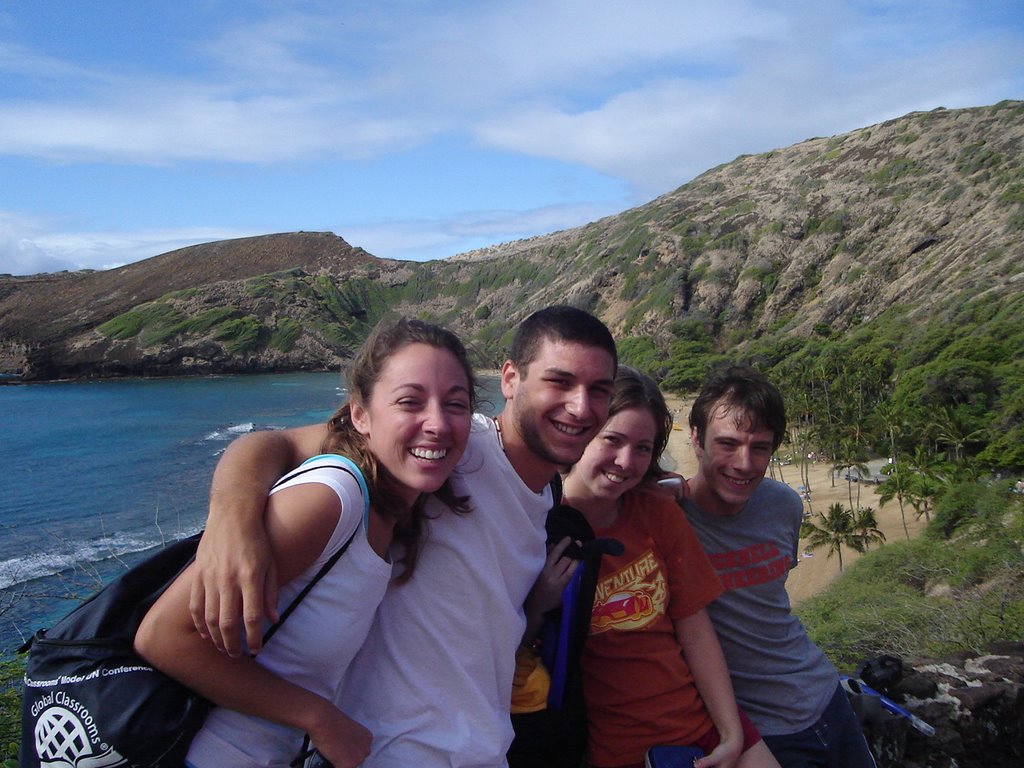
I was excited. This was the only free morning we had in Hawaii and from day one I'd known exactly what I wanted to do with it. I was going to go snorkeling in Hanauma Bay. The weather wasn't perfect today, but I would live.

We caught our first glimpse on the way downhill after the orientation video. The beautiful blue water contrasted nicely with the sandy beach and green vegetation. From above you could see the difference in color- darker shades of blue almost becoming green where the reef was close to the surface.

We sat on the beach struggling to put on our snorkeling gear. Michaela and I had never been before so it was an adventure trying to put on the mask and fins- and then walk in them but we figured it out. Close to shore all we could see was the sand being kicked up by the other swimmers, but then... Imagine stepping into the pages of a National Geographic magazine. I always thought the pictures had to be edited somehow. The was no way the colors could be so vibrant, so rich. But they were. You could reach out and touch fish that were bright yellow and orange, blue, white, black. Rainbow fish. Fish of all shapes and colors. I was in awe. The only thing that disappointed me was the reef. So many people have stepped on it that it was dying and in most places it was nothing more than a big grey blob. If we went out further though there was a little more color because less people had been that far. It wasnt easy. Between the reef and the surface of the water was about a foot in which to swim. Tricky, but definately worth it.

And I'm running out of time so I've got to go. I am in Samoa now though and I'll tell you all about it later. :)

Sunday, September 03, 2006

Tour of Oahu


I didnt get a chance to update yesterday so I'll try and give you the highlights of both days right now. I think definately the best part of yesterday was the private tour I got of the USS Reuben James. One of the former SIT Samoa students is the chief engineer and he took me on a tour of the ship to show me how electricity was made. Definately very awesome. We also had some more language classes (Talofa= hello) and spent the evening with some students from American Samoa.

Today was pretty awesome. We got a tour of Oahu. I wasnt too impressed with Honolulu or Waikiki, but there are some parts of this island that are absolutely beautiful. We got to see some sea turtles, a pineapple plantation, a blowhole, some beautiful rainbows, and absolutely gorgeous beaches. I wish I had more time to tell you about them but I'm borrowing someone else's computer and there's a line. I'll also post some pictures when I get a chance.

Also, just as a warning I leave for Samoa tomorrow afternoon so it might be a day or so before I'm able to update. Dont give up on me though. I will be back. Promise.

Finally, please keep a special intention of mine in your prayers. I'll let you know more later. Thanks! :)

Friday, September 01, 2006

First Contact


In the 1930's a group of gold diggers decided to venture into the interior of Papua New Guinea to search for gold. It was believed to be completely uninhabited. Much was their surprise when they found close to a million people living there. Nobody had known about them before that time. The amazing part is that they actually had a black and white camera with them and were able to record that first contact. The film was placed on a shelf somewhere until the 1970's when it was rediscovered and interviews conducted with the natives and the people in the exploration party. We watched it yesterday during our lunch break. Very very interesting.

Yesterday we had a lecture by Albert Wendt, one of the leading Pacific Island authors. We had to read one of his books before we came to it was interesting to hear him speak. We also had a lecture on social issues and changes which is something that really interests me.

In the afternoon we went to a taro filed on the UH campus and learned about how taro- which was once a staple- was grown. They are trying to preserve a part of their culture which was very close to being lost by teaching students and others the traditional ways of doing things.

In the evening we watched a Pacific Island film called "The Land Has Eyes." The producer and director spoke to us after the film and will be coming again today.

I'm running out of time so I have to run but I was able to upload some of my pictures. You can check them out here: http://s88.photobucket.com/albums/k182/maex1121/

Thursday, August 31, 2006

I'm supposed to eat that?


Let me just start by saying that I've never considered myself a picky eater. I'll try just about anything once, and there are very few things that I haven't liked. Or at least that's what I thought until yesterday evening. Yesterday was our first "drop-off" day. Basically what that means is we are given a task, driven around the city and dropped off in random locations, and told to report back to a certain place at a certain time. The task yesterday was to bring back something we'd never seen before. We were to meet in the International Food Court in Waikiki. Well, 6:30 came and we all gathered with an assortment of food- almost all of it from China Town. I'll be honest, there were some tasty things. Ok so maybe two. The rest...I just couldn't do it. Maybe it was the barrage of different tastes, or maybe it was the way they looked. I dont know. I tasted all of them. Most of them I could not finish. I ate Mexican that night for dinner. Yes I know...Mexican in Hawaii? It wasn't spectacular but it was something I knew.

Let me back up now and talk about the rest of the day. The lectures yesterday focused on the Hawaii sovereignty movement. In high school I'd written a paper on the overthrow of Queen Liliuokalani so I had some idea of the issues involved, but I had not known that many Hawaiian's were so passionate about the issue still. Basically after the missionaries came to Hawaii they also turned to agriculture and commerce and succeeded in becoming very rich and influencial. Some of them became key advisors to the king and were able to direct public policy. Land ownership went from communal to private with missionaries and foreigners owning large chunks of prime real-estate. Over the course of several decades the political intrigues continued, many Hawaiian's were becoming unhappy with the constitution as it stood, and when Queen Liliuokalani attempted to change it the captain of one of the U.S. naval ships brought his men onshore and demanded her surrender to avoid bloodshed. Ok, so it's not exactly everything that happened but its a very general and brief overview. It's been a while since I wrote the paper. What you should take out of this is that the Queen was forced at gunpoint to surrended. She went to Washington to appeal. Nothing was really done. Things just happened and before anyone realized Hawaii was a state. The issue that the soverignty movement has is that Hawaii was an internationally recognized country that became a state and land was taken over by the US government but there was no treaty ever signed. Technicalities perhaps, but also quite big issues when you now consider that many native Hawaiian's have no land. Land for most Pacific Islanders is a huge issue. They see the land almsot as part of themselves. It is a valuable resource because there is so little of it. It is something that must be cared for if it is to in turn provide the resources that will allow them to survive. So yesterday was devoted to lectures on that issue. One of the nice aspects of SIT is that it brings in experts in the different fields so our speakers are lecturing to us on things about which they are very passionate.

After the lectures we went to the Bishop's Museum which houses many cultural items from around the Pacific. It's quite interesting to see the similarities but also the differences across the various islands. It's also just absolutely amazing to see some of the things they made. One of the things that absolutely fascinated me was the way they take the coconut fibers and are able to get them to a point were they can weave mats and nets. Think of the amount of time that would take!!!

From the Bishop's Museum we all left for our drop-off. It was a little different in that we all left from the same place and were just told to go do our own thing. I took the bus to China Town and wandered around there for a little while. Even though I didnt really care for some of the foods that came from there, it was a very interesting place to walk through- especially the food market. The fruits and vegetables they have, the fish, the whole chicken, the randomness of some of the items. It is definately a very different culture. If you've never been to a Chinease market and have a chance to do so- do it. It's interesting. From there I took a bus to King Kamehameha's statue and walked the 5-6 (?) miles back to Waikiki. The weather was perfect for a walk and it was nice to just have the time alone to think. When I got to Ala Moana I turned towards the beach and walked along the water for a little while. All in all, yesterday was a good but long day.